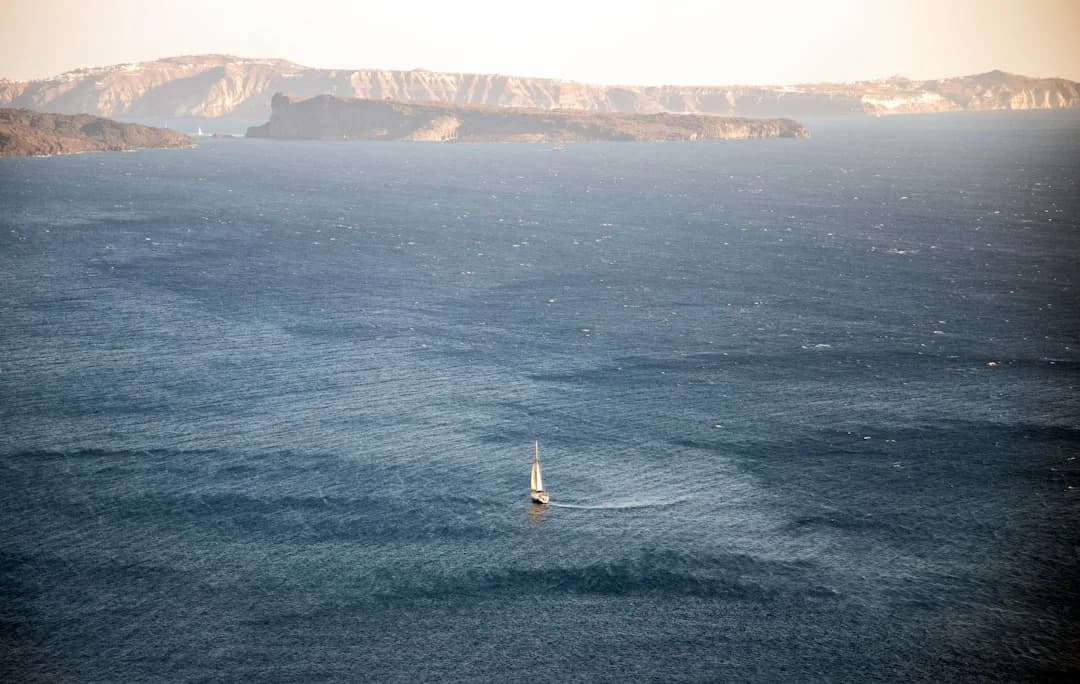
The direct rhumb line from Athens to Santorini is roughly 125 nautical miles, but almost nobody sails it in one shot. The voyage is built for stops — Kea, Kythnos, Serifos, Sifnos, Folegandros — and the prevailing summer wind, the Meltemi, decides your pace whether you like it or not. A typical Athens-to-Santorini cruise covers 140–180 nm over 7–10 days, hopping south through the Western Cyclades.
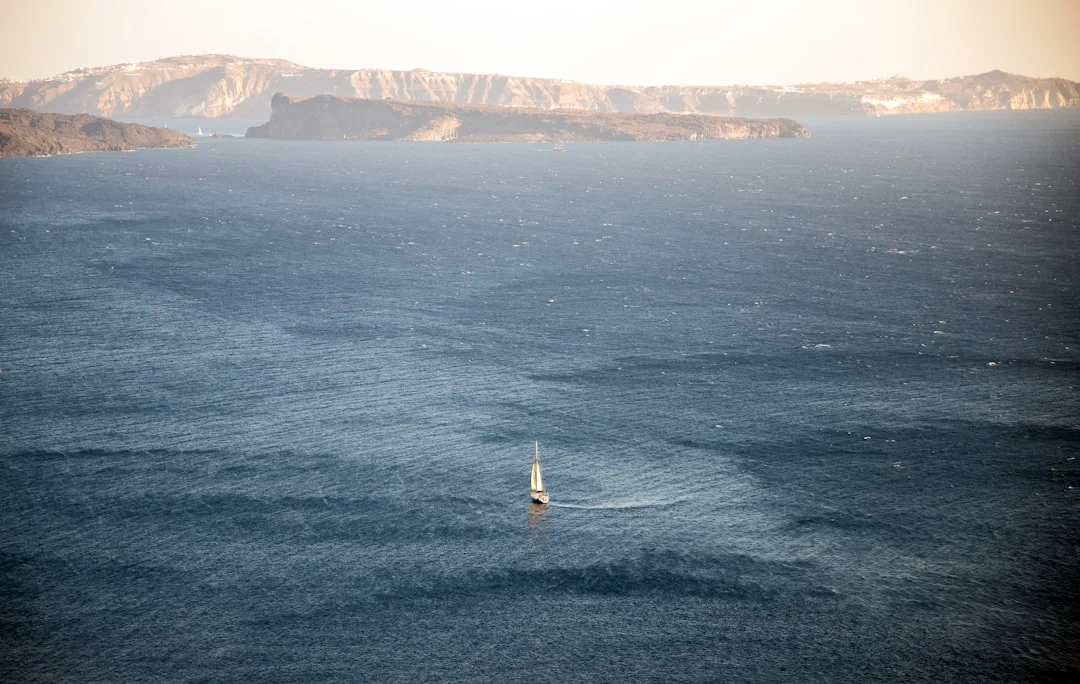
Photo by Sander Crombach on Unsplash
This guide covers what the route actually looks like from a sailor's perspective: which marina to leave from, how to read the Meltemi, where the realistic overnight stops are, what Santorini does to your anchor, and what the trip costs end-to-end. If you want to verify distances between waypoints as you read, keep the calculator open in another tab — port-to-port mileage in the Cyclades adds up faster than people expect once you start factoring in tacks against the wind.
Where the Route Starts: Athens Marinas
"Athens" on a charter contract usually means one of three places, and they are not interchangeable.
| Marina | Location | Boats Based | Notes |
|---|---|---|---|
| Alimos (Kalamaki) | ~7 km south of central Athens | ~1,200 charter yachts | Largest Mediterranean charter base. Most fleets here. |
| Zea Marina | Piraeus | ~600 boats | Closer to ferry port, mixed private/charter. |
| Lavrio | ~60 km southeast of Athens | ~400 boats | Cuts ~25 nm off the southbound trip. Used by crews in a hurry. |
If your priority is getting to Santorini quickly with limited holiday days, Lavrio is worth the taxi ride. Departing from Lavrio puts you at Cape Sounion within an hour and saves a full sailing day compared to leaving from Alimos. If you want the "full" Cyclades experience and a couple of nights in the Saronic Gulf first, Alimos works fine.
Charter check-in in Athens is the same theatre everywhere in Greece: hand over the cruising tax receipt (TEPAH), inventory walk-through, briefing, then a long wait at the fuel dock. Plan for a 14:00–17:00 departure on day one. Don't try to make miles the first afternoon — overnight at Cape Sounion (the Temple of Poseidon anchorage), or push to Kea (Tzia) if the wind is light.
Understanding the Meltemi
You cannot plan a Cyclades passage without planning around the Meltemi. It is a dry, dense, north-to-northwest wind that blows down through the Aegean from roughly mid-May through September, peaking in July and August. Strength on a typical July day: Force 5 to 7, occasionally 8 in the gaps between islands. Direction: almost dead on the nose if you are going from Athens to Santorini.
The wind is not random. It builds during the morning, peaks in the afternoon, and often (not always) eases at night. Local rhythm:
- 05:00–10:00 — calm or light, best window for upwind passages
- 11:00–18:00 — full strength, often F6+ in the channels
- 19:00–01:00 — easing, sometimes dramatically
- 02:00–05:00 — variable, sometimes flat calm
This dictates your sailing day. If you are heading south against the Meltemi, you leave at first light and aim to be tied up or anchored by 14:00, before the wind solidifies. Crews who treat it as a 09:00-departure holiday get punished — clawing into 25 knots with steep seas and the engine working hard.
The Meltemi also creates acceleration zones between islands. The gap between Kythnos and Serifos, the channel south of Sifnos, and the approach to Santorini from the northwest can show 10 knots more wind than the open water either side. Reef early. A first reef in the main and a single roll in the genoa is a sensible default whenever the forecast shows F5 or above.
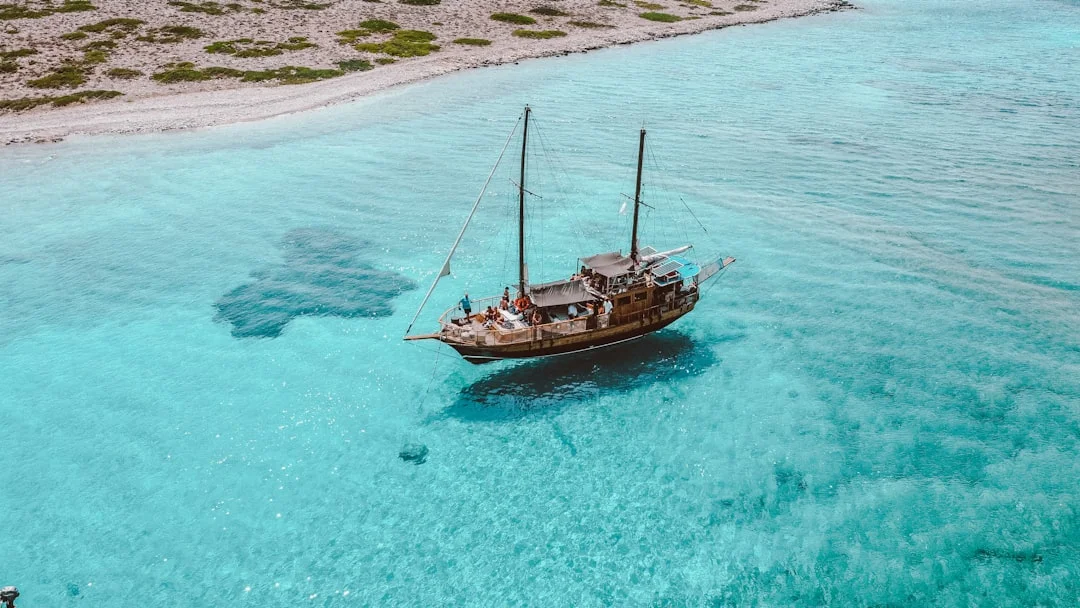
Photo by Johnny Africa on Unsplash
A Realistic 10-Day Itinerary
The classic "Western Cyclades" route is the path of least suffering when sailing south against the Meltemi — the islands give you windward shelter and the leg lengths are sane.
Day 1: Alimos → Cape Sounion (~22 nm)
Late afternoon shakedown. Anchor under the temple in 6–10 m on sand. Swim before dinner. Sunset is genuinely worth the cliché.
Day 2: Sounion → Kea (Vourkari/Otzias) (~18 nm)
Easy reach if the Meltemi is up, motoring through if not. Vourkari is the social port; Otzias is the quiet anchorage on the north coast.
Day 3: Kea → Kythnos (Kolona) (~22 nm)
Kolona is a sand isthmus joining a small islet to the main island. Anchor in either bay depending on wind. One of the most photographed anchorages in Greece for a reason.
Day 4: Kythnos → Serifos (Livadi) (~25 nm)
Livadi has a small marina and a town quay. Tie stern-to with your own anchor. Walk up to the Chora at sunset.
Day 5: Serifos → Sifnos (Vathy or Kamares) (~18 nm)
Kamares is the main port and gets busy; Vathy on the southwest coast is calmer but exposed to southerly swell.
Day 6: Sifnos → Folegandros (Karavostasi) (~30 nm)
Longest single leg. Karavostasi is a small port — anchorage outside the harbour is often necessary in summer.
Day 7: Folegandros → Santorini (Vlychada) (~22 nm)
The arrival. The classic shot is sailing into the caldera; the practical reality is anchoring at Vlychada on the south coast.
Day 8–9: Santorini exploration
Day trip to Thirassia, lunch at Ammoudi, ferry to Oia.
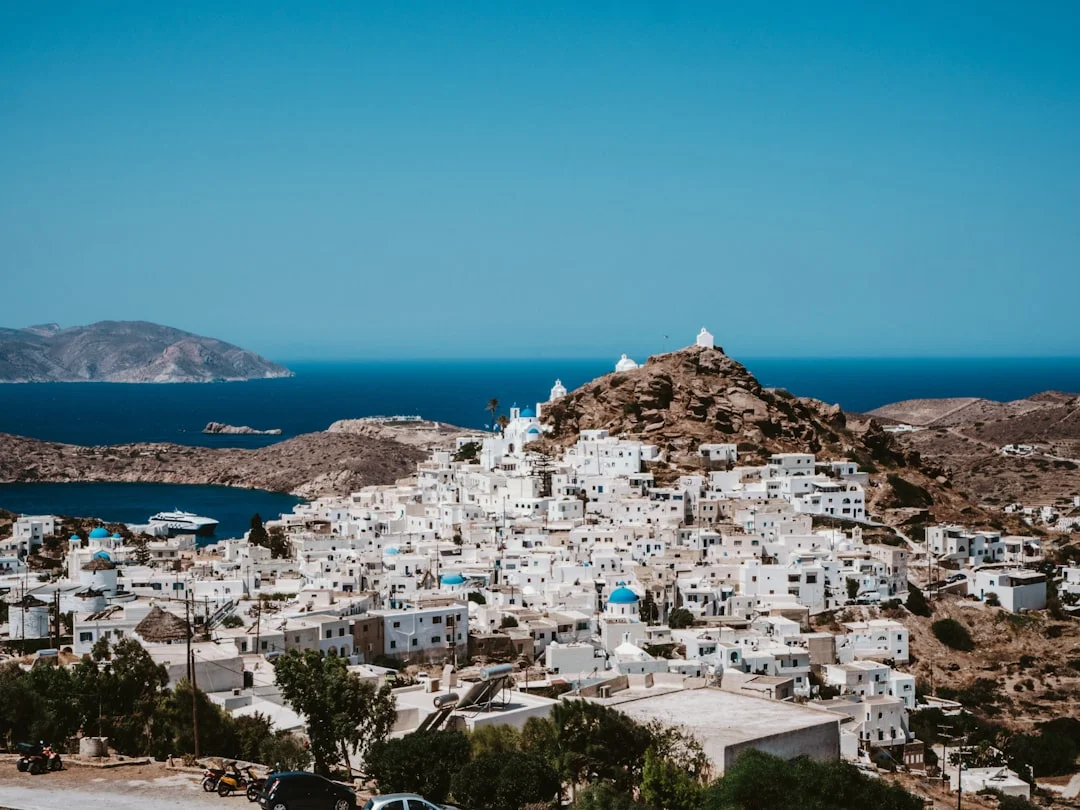
Photo by Johnny Africa on Unsplash
Day 10: Santorini → Ios → Naxos → return
Most charters require return to Athens within 14 days. From Santorini, the trip back uses the Eastern Cyclades with the Meltemi behind you — Naxos, Paros, Mykonos, Kea, Athens. Downwind, fast, much more pleasant than the way out.
If you only have a week, charter one-way from Athens to Santorini (most operators allow this for an extra fee of €400–€800) and fly back. You'll see more and fight the wind less.
Anchoring at Santorini: The Caldera Problem
Santorini is a collapsed volcano. The caldera is a flooded crater 7 km wide and 300–400 m deep in the middle. This is not a typo. There is no anchoring in the caldera itself — your chain will not reach the bottom — and the few mooring buoys near Oia are reserved for tour boats.
Practical options for staying with the boat at Santorini:
- Vlychada Marina (south coast) — small artificial harbour, expensive (~€80–€150/night for a 45-foot yacht in summer), book ahead. Only proper marina on the island.
- Athinios Anchorage — exposed to ferry wash, deep, not recommended overnight.
- Ammoudi Bay (below Oia) — daytime tender stop only, not for overnight.
- Thirassia Anchorage (Korfos) — across the caldera from Fira, decent holding in 8–12 m at the small bay near the village. Best overnight option for caldera views.
- Manolas (Thirassia north) — exposed to north swell with Meltemi, only viable in calm.
The honest answer: most cruisers anchor at Vlychada or Thirassia and ferry over to Fira/Oia for sightseeing. The Insta-perfect "yacht in the caldera at sunset" shot involves either a tour boat or a private mooring you can't get on. If you must spend a night with the caldera view, Korfos on Thirassia is your best shot — and you'll need to be patient with depth and holding before settling in.
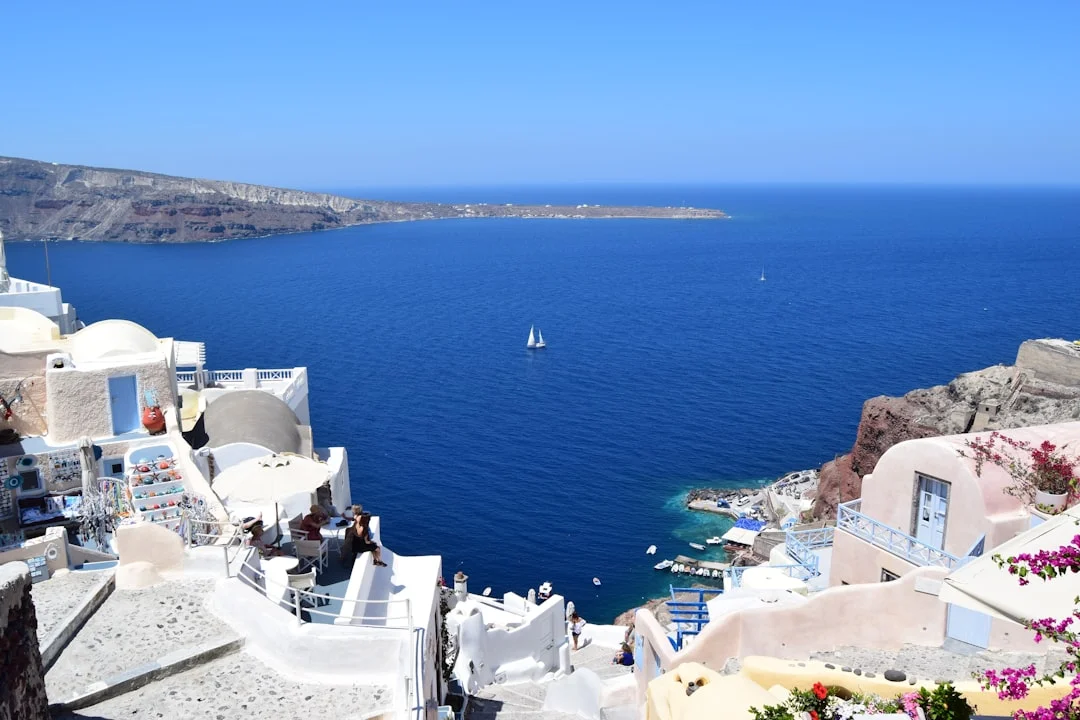
Photo by Matthew Waring on Unsplash
Costs, Permits, and Paperwork
A two-week Athens-to-Santorini bareboat trip on a 45–47 foot monohull, sleeping six, breaks down roughly like this in mid-2026 prices:
| Item | Cost (EUR) | Notes |
|---|---|---|
| Bareboat charter (2 weeks, July) | 5,500–8,500 | High season. May/Sep can be 30–40% less. |
| Skipper (optional) | 1,500–2,000 | Required if no licence holder aboard. |
| TEPAH cruising tax | ~340 | Per week, paid online before departure. |
| One-way fee (Athens → Santorini) | 400–800 | If not returning to base. |
| Marina/port fees | 250–500 | ~€20–€80 per night, varies by island. |
| Fuel | 300–600 | Heavy motoring against Meltemi raises this. |
| Provisioning | 400–700 | Self-catering for the week. |
| Restaurants (10 dinners ashore) | 600–1,200 | Greek tavernas: €25–€60 per person. |
| Cleaning/end fee | 150–250 | Almost always charged. |
| Total per crew of 6 | ~€1,500–€2,500 each | All-in for two weeks. |
If you're comparing destinations or building a budget for the wider Mediterranean, our breakdown of sailing routes and costs around the world covers how Greece stacks up against other major cruising grounds. For the Greek-specific details, calculate the distance between Athens and Santorini on the actual route you'll sail to estimate your fuel needs more precisely — the rhumb line is misleading once you account for tacking.
The required paperwork on board, in addition to charter documents:
- TEPAH receipt (cruising tax) — checked frequently in Cyclades ports
- Skipper licence for at least one crew member, plus VHF certificate
- Crew list with passport details
- Insurance certificate
- Sometimes: ICC (International Certificate of Competence) — Greece accepts most national licences but ICC removes argument
Greek port police are usually polite but they do check. Have everything in a folder ready to hand over.
Provisioning Stops
Provisioning depth drops sharply as you go south. Plan accordingly:
- Athens (Alimos) — full supermarket pickup, big chains within walking distance, pre-order delivery to the boat is standard
- Sifnos (Kamares) — small but well-stocked supermarket, fresh bread, butcher
- Folegandros — minimal, expensive, plan for a "what we have on board" night
- Santorini (Vlychada) — small village shops, full supermarkets in Fira (15-minute taxi)
Water tanks: top up at every opportunity. Greek summer cruising eats freshwater, and not every island has a quay tap. Sifnos and Sounion have reliable water; smaller anchorages do not. If you're new to managing freshwater on a charter, the same discipline applies as on any extended cruise — our guide to sailing the Stockholm Archipelago and Swedish coast covers similar provisioning logic for island-hopping where shore-side resupply is intermittent.
Ice is gold. Buy it whenever you see it.
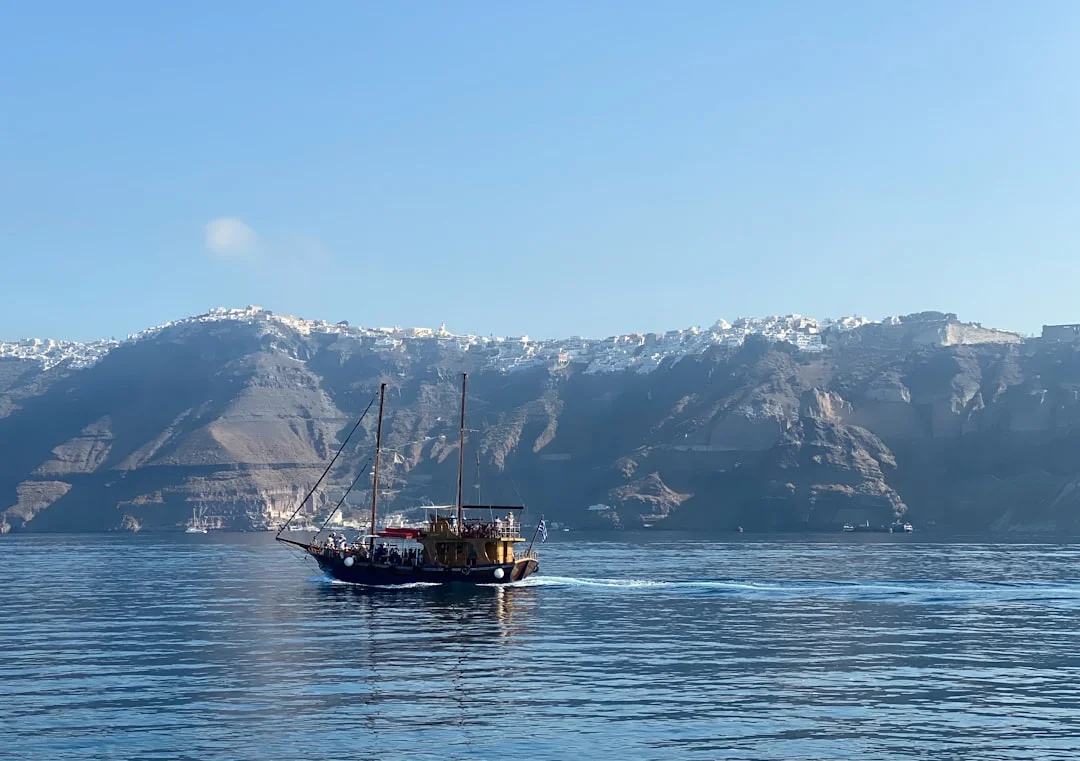
Photo by Victoria Bragg on Unsplash
When to Go
The honest seasonal breakdown for sailing Athens to Santorini:
| Month | Conditions | Verdict |
|---|---|---|
| April | Cool, unsettled fronts, Meltemi absent | Quiet, cheaper, occasionally cold. Risk of gales. |
| May | Warming, light winds, occasional thermals | Best balance — empty anchorages, comfortable upwind sailing. |
| June | 25 °C, Meltemi starting, busier | Good. Plan around afternoon wind. |
| July | Hot, Meltemi solid F5–F7 | Spectacular sailing if you can handle wind. Crowded. |
| August | Hottest, Meltemi peak, packed | Tough upwind passages. Marinas full by 15:00. Expensive. |
| September | Meltemi easing, water still warm | Second best month. Many crews' favourite. |
| October | Variable, cooler, charter season ending | Bargains, but weather windows narrow. |
If you have flexibility, target late May to mid-June or early-to-mid September. You get the same blue-and-white islands, half the people, and significantly more comfortable wind.
Boat Selection: Monohull or Catamaran?
A 45–47 foot monohull is the default Cyclades charter. They handle the Meltemi well, point reasonably upwind, and tie up easily on town quays. Bavarias, Beneteaus, Jeanneaus dominate the fleet.
A catamaran is comfortable at anchor and faster off the wind, but in a Meltemi it has its own problems: catamarans don't sail well to weather, the windage on a 46-foot cat in 30 knots makes Med-mooring memorable, and not every island quay has the space for a 7.5-metre beam. Berthing fees are also typically double for cats.
If your group is six adults who want maximum comfort at anchor and you can plan around the wind, a cat is fine. If you want to actually sail the route — including the upwind legs — take the monohull.
What Goes Wrong
A few realities worth knowing before you go:
- Stern-to mooring (Med-moor) is universal in the Cyclades. If you have never done it, get the briefing in Athens and practise once before you arrive at a busy quay in 25 knots of crosswind.
- Anchor drag is common in deep, weedy holding. Sifnos and Folegandros have patchy bottoms. Set a snubber, dive on the anchor if visibility allows, and check at 03:00.
- Lazy lines at marina quays are often coated in slime and sometimes broken. Bring gloves.
- Ferry wakes in some harbours (Vlychada, Athinios) are violent. Move outside if a ferry is due.
- Petty theft at unattended dinghies is occasional in tourist ports — lock the outboard.
These are not deal-breakers. They are the standard texture of Cyclades cruising. Crews who arrive expecting flat water and gentle breezes are the ones who have a bad time.
Frequently Asked Questions
How long does it take to sail from Athens to Santorini?
Direct, in calm weather, the 125 nautical mile rhumb line can be sailed in around 24 hours of continuous motoring or fast reaching. In practice, with the Meltemi on the nose and stops built in, plan 7 to 10 days for a relaxed cruise through the Western Cyclades. Crews trying to do it faster usually end up motoring most of the route into headwinds — not the holiday they paid for.
Can a beginner sail this route?
A confident skipper with bareboat-level experience can do it, but the Cyclades is not the place to learn upwind sailing or Med-mooring. The Meltemi is consistent and strong, and Greek anchorages can be deep and weedy. If your bareboat experience is limited to the Ionian or the Caribbean, hire a skipper for the first week — you'll learn faster and damage less. Pure novices should take a sailing course before chartering here, not during.
What size boat do I need?
For 4 to 6 adults on a two-week trip, a monohull between 42 and 47 feet is the sweet spot. Smaller and you'll be cramped after a few days; larger and Med-mooring on a busy island quay becomes genuinely stressful. For 7 to 8 people, a 47–50 foot monohull or a 45-foot catamaran works. Solo or couple? A 38–40 foot boat is plenty and much easier to handle short-handed.
Is it safe to sail to Santorini in August?
Yes, if you respect the Meltemi. August routinely produces F6 to F8 in the Cyclades, and the seas between islands get steep and short. Departures should be at dawn, reefing should be early, and you should be tied up by mid-afternoon. Boats and crews get into trouble when they ignore the timing — leaving Sifnos at 11:00 to make Folegandros against 35 knots is how rigs break and seasickness wins. The wind is not dangerous if you sail with it; it is dangerous when you fight it carelessly.
Where should I anchor at Santorini?
The caldera is too deep to anchor — 300+ metres in most places. Realistic options are Vlychada Marina on the south coast (book ahead, expensive, only proper marina on the island), Korfos on Thirassia (the small island opposite Fira — quiet, decent holding, classic caldera view), or day-stops at Ammoudi below Oia. Most cruisers spend a night at Vlychada and a night at Thirassia, then move on.
Can I sail one-way from Athens to Santorini?
Yes — most major charter operators in Athens (Alimos and Lavrio bases) offer one-way charters terminating in Paros, Mykonos, or occasionally Santorini itself. Expect to pay an extra €400–€800 as a relocation fee, and book early because one-way slots are limited. For a 7-day trip, this is by far the best option — you sail downwind on the Meltemi for the whole route and fly home from Santorini's airport instead of fighting back upwind.
About the Author
Related Articles
Amalfi Coast vs French Riviera Sailing Guide (Costs & Routes)
Compare Amalfi Coast vs French Riviera sailing—costs, crowds, mooring rules, best months, and 7-day routes. Choose your coast and plan now.
By Breezada Team
Puget Sound Cruising Guide to Gulf Islands Routes
Plan routes, anchorages, and weather windows with this Puget Sound cruising guide for the Gulf Islands & San Juans. Read now and start plotting.
By Breezada Team
Sailing Amalfi Coast Guide: Ports, Anchorages & Rules
Sailing Amalfi Coast guide to Capri, Positano & Amalfi: best ports, anchorages, fees, VHF and rules. Plan your route—read now.
By Breezada Team
Dry Tortugas Sailing: Routes, Anchoring & Permits
Plan Dry Tortugas sailing from Key West with routes, weather windows, anchoring/moorings, and permits. Read the guide and plan your trip.
By Breezada Team