BVI Sailing Itinerary: 7 Days, Moorings & Permits
BVI Sailing Itinerary: 7 Days, Moorings, Permits (with Real Distances and Costs)
A good BVI sailing itinerary isn’t about cramming in every postcard. It’s about short legs, early arrivals, and having a Plan B when the mooring field looks like a Costco parking lot on Saturday. The British Virgin Islands reward crews who plan in nautical miles, sail in daylight, and keep expectations realistic for a 7-night charter rhythm.
Photo by Markos Mant on Unsplash
Quick overview: what a 1-week BVI charter really looks like
Most BVI charters are 7 nights, Saturday-to-Saturday, and Day 1 is rarely a “cast off at noon” fantasy. Between paperwork, provisioning hiccups, and the operator briefing, plan on 2–4 hours for check-in, base orientation, and a chart talk that may or may not match what you see outside the breakwater. If you leave the dock by 1500, you’re doing fine; if you leave by 1100, buy a lottery ticket.
The BVI is “easy mode” for bareboat because it’s line-of-sight island hopping with legs that commonly run 6–12 nautical miles. You’re usually sailing in protected water with bail-out options every few miles, which is why it’s popular for first-time skippers and mixed-experience crews. That said, the reefs are real, the entrances are narrow in places, and late arrivals are how people end up learning stress management techniques.
Peak season brings NE trades around 15–25 knots, and winter fronts can briefly add more wind plus a chunk of north swell. That wind direction matters: many classic legs are comfortable reaches, but north-shore anchorages can get “swell wrap” that turns sleep into a full-contact sport. Build your week around south-coast protection when the forecast looks punchy, and treat north-facing bays as a fair-weather privilege.
Success in the BVI isn’t measured by how far you sailed; it’s measured by how calm your evenings are. Plan 2–4 hours underway per day, and aim to be in the popular mooring fields by 1–3 pm to materially improve your odds. Use plan your route using a sea distance calculator before you go to pre-compute legs in nm and ETAs at 5/6/7 knots, then decide your “latest safe departure” that still guarantees a daylight entrance.
7-day BVI sailing itinerary (Tortola–Norman–VG–Anegada–JVD)
This BVI 7 day sailing itinerary is built for first-timers who want short passages, high-probability moorings, and the right timing for The Baths and Anegada. Distances are approximate because your exact routing depends on wind angle, traffic, and which side of the channel you choose. For planning, assume a conservative 5–7 knots average, and remember that a 12 nm leg often becomes 2–3 hours once you count sail handling and other boats doing unpredictable things.
Day 1 (Sat): Road Town check-in → Norman Island (The Bight)
After base check-out, head to Norman Island; Road Town to The Bight is ~6–8 nm depending on your track. At 5.5–6.5 knots, that’s roughly 1–1.5 hours underway, plus time to sort out fenders, lines, and the fact that someone already lost their hat. Try to arrive before 1500, because The Bight fills fast in peak weeks.
Day 2: Norman/Peter Island options → Cooper Island (Manchioneel Bay)
If the crew wants a warm-up, you can poke over toward Peter Island for a snorkel before turning east. Norman to Cooper is commonly 6–10 nm, and you’ll usually be sailing in water that feels forgiving, even when it’s busy. Your goal is still the same: be picking up a ball by 1300–1500 instead of circling with 20 other boats pretending they’re not stressed.
Day 3: Cooper → Virgin Gorda (Spanish Town) and The Baths timing
Cooper to Spanish Town is typically 7–10 nm, and the approach is straightforward if you arrive in daylight and don’t freestyle the buoys. For The Baths, timing matters more than speed: arrive early enough to beat the day boats, ideally before 1000 if you want the “not shoulder-to-shoulder” experience. Spanish Town also sets you up nicely for an Anegada run when conditions allow.
Day 4: Virgin Gorda → Anegada (reef navigation and daylight approach)
This is the leg that deserves respect, not fear. Virgin Gorda to Anegada is often in the 12–15 nm range depending on departure point, and at 6 knots you’re looking at 2–2.5 hours, plus setup time for a careful approach. Plan it so you arrive with a big daylight cushion; Anegada is low-lying, and reef navigation is not the place for a “we’ll be fine” sunset entrance.
Day 5: Anegada lay day (north-shore swell and beach selection)
Anegada is where the BVI feels like it has room to breathe, but it’s also where north swell can make certain spots sloppy. If the forecast shows lingering north swell, pick your beach and anchorage accordingly and don’t assume every shoreline is equally comfortable. Give the crew a land day, check your systems, and enjoy not moving for once.
Day 6: Anegada or VG → Jost Van Dyke (Great Harbour or White Bay)
If it’s settled, you can go Anegada to JVD in a longer hop (often 18–22 nm depending on routing), but many crews prefer to break it with a stop back near Virgin Gorda. If it’s breezy at 20–25 knots, the long leg can turn into a motor-sail grind, and nobody thanks the skipper for “character-building.” Great Harbour is convenient; White Bay is iconic, but it’s also where you learn the difference between “anchored” and “anchored comfortably.”
Day 7 (Fri): Jost → Tortola base (fuel/water, checkout readiness)
Jost to the Tortola bases is commonly 8–12 nm, which should be an easy half-day even at 5.5 knots. Leave time for fuel dock lines, water top-ups, and the checkout list you swore you’d start yesterday. This is also when checking the nautical miles for your planned route helps: compute your realistic ETA, then back-time a departure that avoids arriving in the same parade as everyone else.
Photo by Karla Car on Unsplash
Practical tip: In the BVI, your best “secret weapon” is not sailing faster—it’s arriving earlier. If you’re not on a mooring by 1500, assume you’ll use your backup plan.
Mooring balls vs anchoring in the BVI: technique, rules, and backup plans
How BVI mooring fields work (and where anchoring is restricted)
The BVI runs on mooring balls, and many popular bays have designated fields where anchoring is restricted or discouraged to protect the seabed and reefs. The pick-up gear is generally sized for the typical 35–50 ft charter monohulls and cats, but “generally” is doing a lot of work there. Your job is to treat every ball like it was installed by a well-meaning person who doesn’t have to sleep on your boat tonight.
When a field is full, don’t get cute inside the pack. Move to the edge, consider anchoring outside the marked area where allowed, or divert to a nearby bay with similar protection. A skipper who insists on forcing the “perfect” stop is usually the one who ends up with the worst night.
Safe pickup and attachment: boat hook, pendant condition, and chafe control
Approach slowly—think dead slow, 1–2 knots—with the helm keeping the ball just off the leeward bow. Put a calm, competent crew on the bow with a real boat hook, not a snorkel pole and optimism. Once you have the pendant, inspect it: if it’s chafed, stiff, or looks sun-cooked, you rig your own line through the ring or use a backup bridle rather than trusting a single tired strand.
Chafe is the silent budget killer of charter weeks. Lead the pendant so it doesn’t saw across a bow roller or sharp fairlead, and add chafe gear if you have it. ABYC H-40 is the right reference here: strong points, proper leads, and chafe protection are not “nice-to-haves” when the breeze sits at 20 knots all night.
Catamaran bridle setup: load sharing and yaw reduction (ABYC H-40 tie-in)
On a cat, a bridle is not optional if you want quieter sleep and less shock loading. Use two lines to the port and starboard bow cleats (true strong points), with lengths that keep the central connection low and forward, reducing yaw. Keep the lead angles fair, avoid crossing the bridle over anchor rollers, and protect any spot that touches gelcoat or hardware for 8–12 hours of motion.
Redundancy matters because charter gear lives a hard life. If the mooring pendant looks marginal, clip a secondary line to the ring as a backup, and make sure both legs share load rather than leaving one slack. The goal is simple: no jerking, no rubbing, and no “mystery noises” at 0300.
When to anchor outside fields: depth targets, scope math, and swing room
If you anchor, do it like you mean it. In the BVI you’ll often see depths of 10–30 ft (3–9 m), and many crews target 12–20 ft (3.5–6 m) for good holding without putting the boat in the next zip code. Use scope math you can defend: 5:1 in settled conditions, 7:1 when squalls are expected or holding is suspect.
Example: 15 ft depth plus 5 ft bow height equals 20 ft total. At 5:1, that’s ~100 ft of chain; at 7:1, it’s ~140 ft. After you set, take transits or use an anchor alarm, then run a reset drill if anything feels off: re-check bite, confirm swing room, and don’t pretend dragging is “probably fine.”
Photo by Ian Keefe on Unsplash
Permits, clearance, and operating rules (customs, parks, and compliance)
“BVI cruising permits and fees” is the phrase people use for a mix of clearance charges, park fees, and operator line items that show up on the invoice in ways that aren’t always intuitive. Most crews will handle the bulk of it through the charter company at check-in, but you still need to understand what you’re paying for and what documents you must have on hand. Build time for admin on Day 1; it’s part of the Saturday-to-Saturday rhythm, not a disruption to it.
Bring a clean document package: passports, a printed crew list, your charter contract, and any qualification documentation the operator requires (some want a sailing resume or certification). Keep digital copies too, but don’t rely on a phone that may be dead by the time you’re asked for details. If you’re traveling with kids, confirm any special consent letters your home country recommends, because that’s a preventable headache.
Plan for site and national park fees at certain stops, with typical ranges around $3–$10 per person per site (subject to change). The Baths is the obvious example where timing and fees collide: arrive early, pay what’s required, and don’t assume every kiosk takes the same payment method. Carry small bills; the BVI has a way of turning “we’ll pay later” into “we’ll skip it.”
On-the-water compliance is mostly common sense, but standards exist for a reason. ABYC H-41 covers good navigation and anchor light practice: show the right lights at dusk, and don’t motor around in twilight with “it’s probably fine” lighting. USCG 33 CFR 175 is relevant for US-flagged vessels and aligns with what good operators expect anyway: wearable PFDs aboard, and kids’ sizing confirmed before you leave the dock.
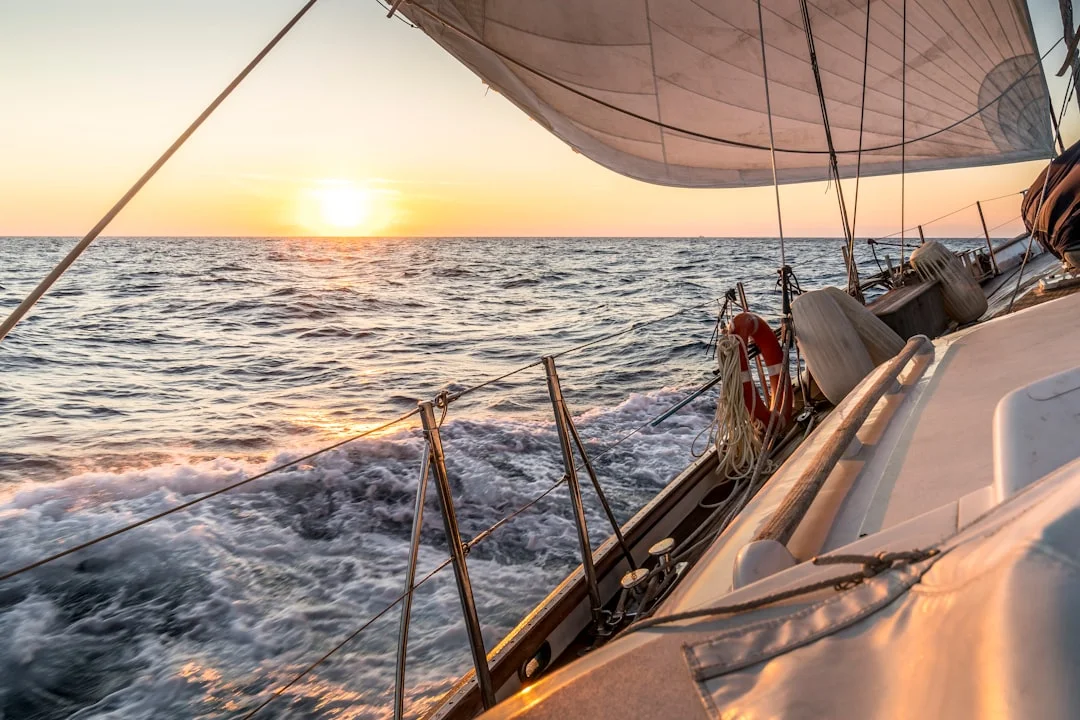
Photo by Marc Wieland on Unsplash
What a 1-week BVI sailing trip costs (charter, moorings, food, extras)
Fixed vs variable costs: what scales with boat size vs crew count
The biggest mental trap in BVI sailing costs is assuming the sticker charter price is “most of it.” It’s most of the fixed cost, yes, but moorings, food, drinks, fuel, and park fees add up fast, especially if you eat ashore 4–6 nights. The boat size drives the base price, damage waiver or deposit, and sometimes mooring fees; the crew count drives provisioning and bar tabs with ruthless efficiency.
Use realistic weekly ranges: monohull 35–45 ft often runs $3,500–$9,000+, while a 40–50 ft catamaran can be $6,500–$18,000+ depending on season and how new it is. Damage waiver programs are commonly $300–$700/week, while refundable deposits often sit around $3,000–$8,000 if you skip the waiver. Mooring balls (where charged) commonly land in the $25–$60/night range.
All-in budget scenarios for 4 vs 8 people (how costs split)
Here’s where the math gets honest. Two couples on a 40-foot cat will often pay more per person than eight friends on a 45–50 footer, because the fixed costs don’t scale down politely. Provisioning commonly runs $150–$350 per person per week, drinks another $75–$300, and fuel is often $150–$450/week depending on engine hours and whether you motor-sailed into 20 knots all week.
If you add a captain at $250–$400/day plus 10–15% gratuity, you’re buying competence and less stress, but it’s not a small line item. A cook at $200–$350/day plus tip can be worth it for groups who want to actually relax, but you’ll still pay for provisions. Your best cost-control lever is simple: mix 3–4 restaurant nights with 3–4 onboard-cooking nights and keep lunches easy.
Cash-flow planning: what you pay upfront vs on-island
Plan cash flow like a skipper, not like a tourist. Charter cost and many base fees are usually paid upfront; provisioning is often paid before departure; moorings, park fees, and bar nights happen in drips that feel small until you total them. Carry enough cash for small fees and tips, but don’t carry so much you’ll be upset if it goes swimming.
Distances also affect fuel costs more than people admit. If you pre-calc your legs and ETAs with estimate your fuel needs based on the voyage distance, you can estimate likely engine hours at 6–8 knots and keep fuel burn predictable. That’s not about penny-pinching; it’s about avoiding the Friday fuel dock surprise when everyone is tired.
| Cost item (7 nights) | Typical range | Fixed or variable? | Notes / what drives it | Example per-person (4 guests) | Example per-person (8 guests) |
|---|---|---|---|---|---|
| Bareboat monohull (35–45 ft) | $3,500–$9,000+ | Fixed (boat) | Season, age, promotions | $875–$2,250 | $438–$1,125 |
| Bareboat catamaran (40–50 ft) | $6,500–$18,000+ | Fixed (boat) | Cabin count, newness | $1,625–$4,500 | $813–$2,250 |
| Damage waiver | $300–$700 | Fixed-ish | Alternative to $3k–$8k deposit | $75–$175 | $38–$88 |
| Mooring balls | $25–$60/night | Variable (choices) | 5–7 nights typical | $31–$105 | $16–$53 |
| Fuel | $150–$450/week | Variable (routing) | Engine hours, sea state | $38–$113 | $19–$56 |
| Provisioning (food) | $150–$350/person | Variable (crew) | How much you cook aboard | $150–$350 | $150–$350 |
| Drinks / bar nights | $75–$300/person | Variable (crew) | Restaurant frequency | $75–$300 | $75–$300 |
| Park/site fees | $3–$10/person/site | Variable (choices) | Baths, parks, etc. | $10–$40 | $10–$40 |
| Optional captain | $250–$400/day + tip | Fixed add-on | 5–7 days typical | +$313–$700 | +$156–$350 |
Photo by Tim Gouw on Unsplash
Navigation, weather, and safety for reef-fringed island hopping
Weather patterns that change decisions: trades, fronts, squalls, and swell wrap
Peak-season trades commonly sit around 15–25 knots, and that’s enough to make a “short hop” feel long if it’s on the nose. Your routing should chase comfortable angles: reaching is fast and happy, close-hauled in charter chop is slow and cranky, and motor-sailing becomes the compromise nobody brags about. Winter fronts can spike wind and increase north swell, which is when north-facing bays go from charming to exhausting.
Swell wrap is the big comfort variable for a British Virgin Islands sailing guide that tells the truth. A bay that looks protected on the chart can still roll if swell bends around a headland, and you won’t sleep well at 10–15° of hobby-horsing. In those weeks, the south-coast stops—Norman, Peter, Cooper, and other lee anchorages—are the easy button.
Reef navigation essentials: daylight piloting, entrances, and under-keel margins
The BVI rewards slow, deliberate piloting near reefs. Keep arrivals in full daylight, post a bow lookout when the water shallows, and cross-check plotter data with what your eyes see. Maintain at least 3 ft (1 m) under-keel clearance plus tide and swell margin when you’re anywhere near a reef edge, because “charted 8 feet” becomes “surprise” quickly.
Use real navigation tools, not just vibes. Most charter fleets provide plotters (Garmin and Raymarine are common), and paper backups are still smart when screens get weird at the worst time. If you’re planning the Tortola to Virgin Gorda sailing route or an Anegada sailing from Virgin Gorda day, pre-calc the leg distance, ETA, and latest safe departure so you’re not tempted into a late entrance.
Day-1 safety and systems checks (ABYC/ISO/USCG-aligned)
Day 1 is when you prevent the trip-ending failures. Check seacocks and thru-hulls per ABYC H-27, and confirm you know what “normal” bilge activity looks like in the first hour. Verify navigation lights and anchor light operation per ABYC H-41, because dusk comes quickly and the mooring field doesn’t care about your excuses.
On power and charging, ABYC E-11 is the right mindset: don’t overload the inverter with high-draw appliances, and know where the battery monitor is before you need it. Many charter boats carry 400–1,000 Ah battery banks (12 V equivalent), and they can still be drained fast by watermakers, induction cooktops, or “let’s run the kettle again.” ISO 12217 is worth remembering as context: these boats are designed for coastal operation, but they’re not meant to be hammered offshore just because you’re feeling confident.
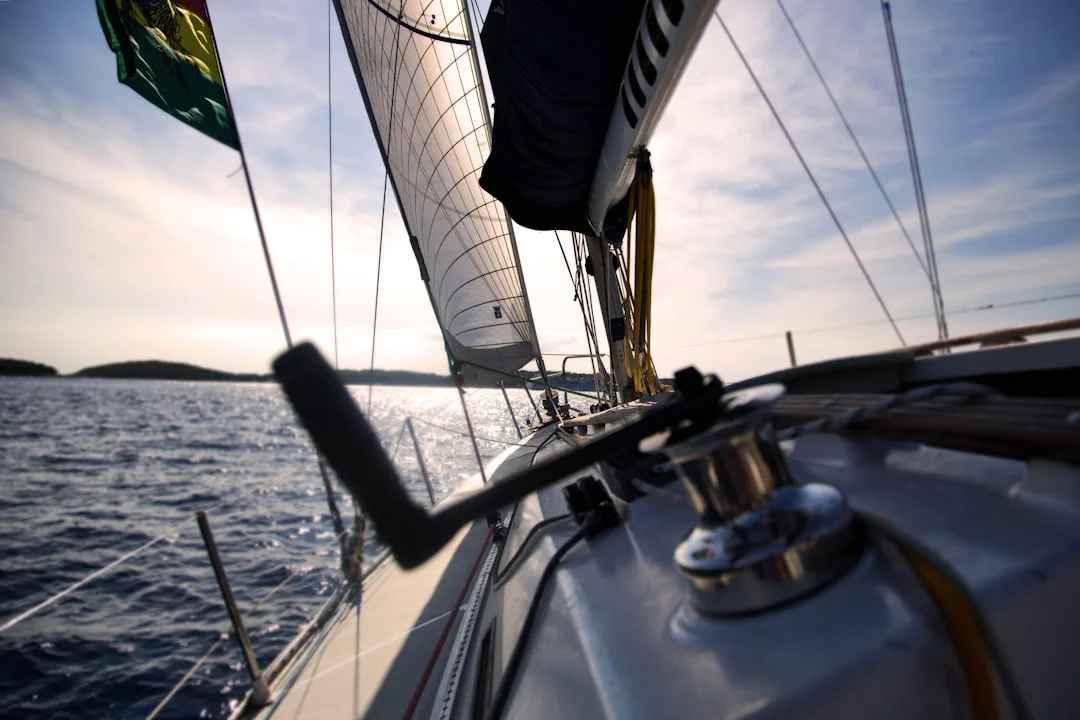
Photo by Jonathan Smith on Unsplash
Provisioning and onboard resource management (water, fuel, power, packing)
Provisioning strategy for a 7-night catamaran charter week
Provisioning for a catamaran charter week is mostly about buying heavy staples once and then doing small top-ups when you can. Load Tortola with breakfast basics, lunches you can assemble underway, and dinners that don’t require six burners and a culinary committee. Keep the first night simple—tacos, pasta, or grilled something—because Day 1 already has enough moving parts.
What runs out first is rarely “food.” It’s usually ice, drinking water discipline, and patience with the battery monitor. If you plan 3–4 restaurant nights and 3–4 onboard-cooking nights, you’ll control cost and keep the galley from becoming a 24/7 job site.
Water and fuel management: tankage assumptions and top-up habits
Typical tankage varies widely, so confirm your exact numbers on the yacht listing. Many boats carry ~40–100 gallons of fuel and ~100–250 gallons of water, and the difference between 120 and 220 gallons is the difference between relaxed showers and suspicious silence when someone turns on the tap. Even if water top-ups are available, they may cost ~$0.20–$1.00 per gallon equivalent or be bundled depending on the dock.
Make daily tank checks routine: morning glance at water, fuel, and battery state, then a quick plan for the day’s use. If you’re returning to Tortola on Friday, top up earlier if you can; the fuel dock queue is not where you want to spend your last afternoon. Use Breezada’s sea distance calculator to estimate motoring miles for the week, then translate that into likely gallons burned based on your boat’s real-world consumption.
Power management at anchor/mooring: inverter loads and generator etiquette
Most charter boats run 12 VDC with 110/220 VAC through an inverter/charger and sometimes a generator. High loads like electric kettles, hair dryers, and air conditioning can crush batteries fast, even with a 600 Ah bank that sounded enormous on paper. If you have a generator, use it intentionally—charge hard for a defined window, then shut it down—because running it for hours to power one phone charger is how you become unpopular.
Galley safety is part of resource management. If you’re cooking on LPG, treat it seriously and align habits with ISO 10239: sniff checks, proper shutoffs, and no “we’ll just leave it cracked.” The BVI is forgiving, but fire at sea is not.
| Category | Must-haves (pack) | Nice-to-haves (pack) | Buy on Tortola | Wait until islands / don’t rely on it |
|---|---|---|---|---|
| Documents & money | Passports, crew list, charter contract, 2 credit cards | Printed insurance details, spare ID photo | Small bills for fees/tips | Specialty printing/scanning |
| Sun & water | Reef-safe sunscreen, hats, polarized sunglasses | SPF shirts, extra sunglasses strap | Drinking water starter, ice | Specific sunscreen brands |
| Snorkel & swim | Mask that fits, fins (optional), rash guard | Dry bag, swim buoy | Cheap snorkel sets | Perfect sizing availability |
| Boat utility | Headlamp, soft luggage, reusable bottle | Small chafe tape, microfiber towels | Trash bags, zip bags | Marine-grade spares |
| Tech & nav backup | Phone mount, charging cables | eSIM/SIM ($10–$40), small power bank | Local data plan if needed | Fast Wi‑Fi everywhere |
Frequently Asked Questions
For a Tortola → Norman Island leg of 8 nm, what departure time ensures arrival by 1:30 pm assuming a conservative 5.5 kn average plus 30 minutes for sail handling and traffic?
At 5.5 knots, an 8 nm leg takes about 1.45 hours (8 ÷ 5.5 = 1.454 hr ≈ 1 hr 27 min). Add 30 minutes for sail handling and traffic, and you’re at roughly 1 hr 57 min total. To arrive by 1:30 pm, plan to depart no later than 11:33 am, and earlier if you expect congestion at the mooring field.
When picking up a BVI mooring, how should a catamaran rig its bridle (lead angles, chafe points, and redundancy) to align with ABYC H-40 strong-point guidance?
Use a two-leg bridle from both bow cleats/strong points, with fair leads that avoid sharp edges and keep the load symmetric. The bridle should meet at a central attachment point (or both legs directly to the pendant) that sits low and forward to reduce yaw and shock loads overnight. Add chafe protection where lines touch rollers or gelcoat, and if the pendant looks worn, rig a secondary backup line to the ring so one failure doesn’t become a drift story.
At 18 ft charted depth with 4 ft bow height and a 7:1 scope target, how much chain should you deploy, and how should you adjust for a forecast nighttime squall line?
Total rode calculation depth is 18 + 4 = 22 ft. At 7:1, you want about 154 ft of chain/rode (22 × 7 = 154). With a squall line forecast, increase scope if swing room allows (often toward 8:1), confirm your anchor is well set, and run an anchor alarm with a radius that matches your actual scope.
In a week with 20–25 kn NE trades and north swell, which BVI anchorages are most prone to swell wrap, and what routing changes minimize uncomfortable nights?
North-facing bays and open beaches are the usual offenders when north swell is running, even if the wind is manageable. In those conditions, favor south-coast protection—stops like Norman, Peter, and Cooper tend to be calmer—and treat north-shore stops as conditional rather than mandatory. Route choices that keep you in lee water and reduce overnight roll will do more for crew morale than any single “must-see” bar.
If your charter cat's engines burn ~1.5 gph each at 7 kn under power, how many engine-hours fit within a 40-gallon usable fuel budget while preserving a 20% reserve?
A 40-gallon usable budget with a 20% reserve means you can plan to burn 32 gallons (40 × 0.8 = 32). Two engines at 1.5 gph each equals 3.0 gph total. So you have about 10.7 engine-hours available (32 ÷ 3.0 ≈ 10.67) at that burn rate, which is a useful planning cap for a week.
If you want this itinerary to run like a skipper wrote it (not like a brochure), keep the legs short, arrive early, and build condition-based options for north swell. Plan in nautical miles with 5–7 knot averages, treat moorings and anchoring like real seamanship (scope math included), and manage water/power like you’d like to avoid a mutiny. That’s the difference between “we did the BVI” and “we slept well and want to come back.”
About the Author
Related Articles
How to Reef a Sail: Slab vs Single-Line Systems
Learn how to reef a sail with slab vs single-line systems. Compare pros, cons, and steps—read now and reef with confidence.
By Breezada Team
Best Boat Heater: Diesel vs Propane vs Electric
Compare diesel, propane, and electric heat to find the best boat heater for liveaboards. See pros, cons, and choose your setup today.
By Breezada Team
Sailboat Rigging Inspection: Checklist & Intervals
Use this sailboat rigging inspection checklist and service intervals to spot issues early. Read now and download the checklist before your next sail.
By Breezada Team
Best Sailboat for Beginners: Size, Type & Budget
Find the best sailboat for beginners by size, type, and budget. Compare top options and choose your first boat with confidence—read now.
By Breezada Team