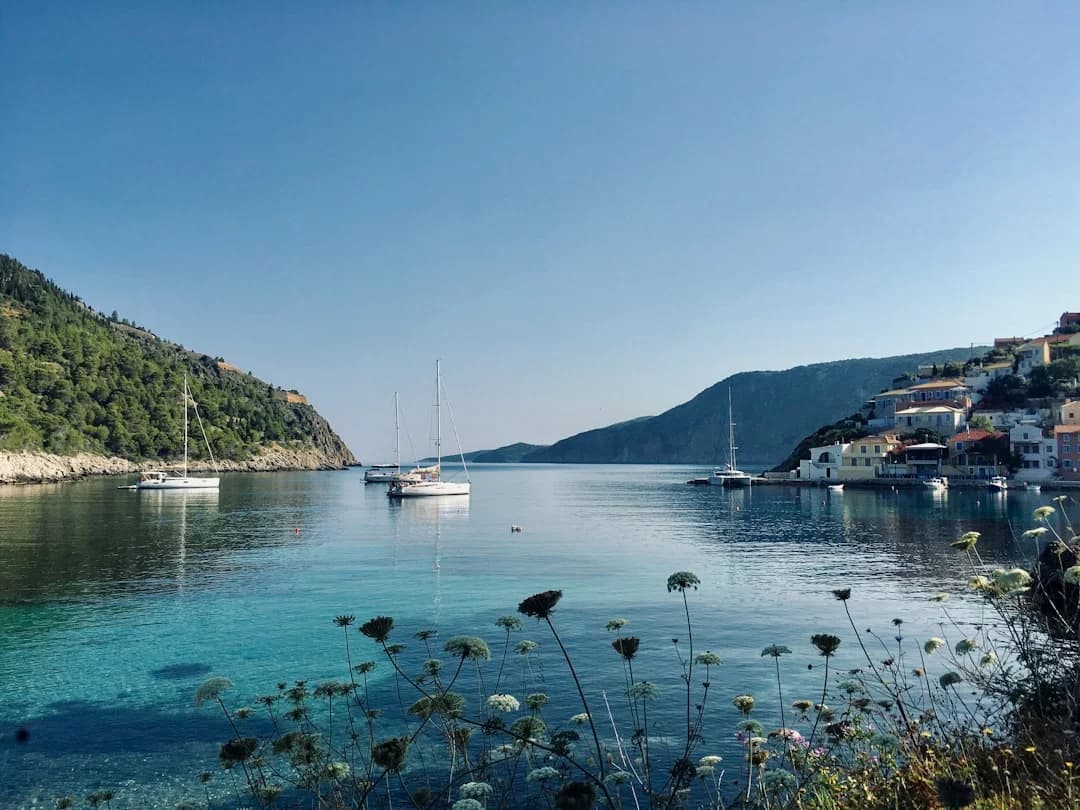
Sailing in Greece: Cyclades, Ionian & Dodecanese (Winds, Routes, Costs)
Greece rewards crews who plan in knots, nautical miles, and euros—not vibes. The Cyclades can hand you 25–35 kn of Meltemi and short, steep chop; the Ionian often serves up 10–18 kn afternoon sea breeze with plenty of shelter; the Dodecanese sits in between, with 15–25 kn and some very real acceleration funnels.
Use Breezada’s sea distance calculator early, before you fall in love with a route that’s 10 NM longer than you think. Those “little” errors show up as late arrivals, packed quays, and dinners you eat standing in a cockpit with a stern line in your hand.
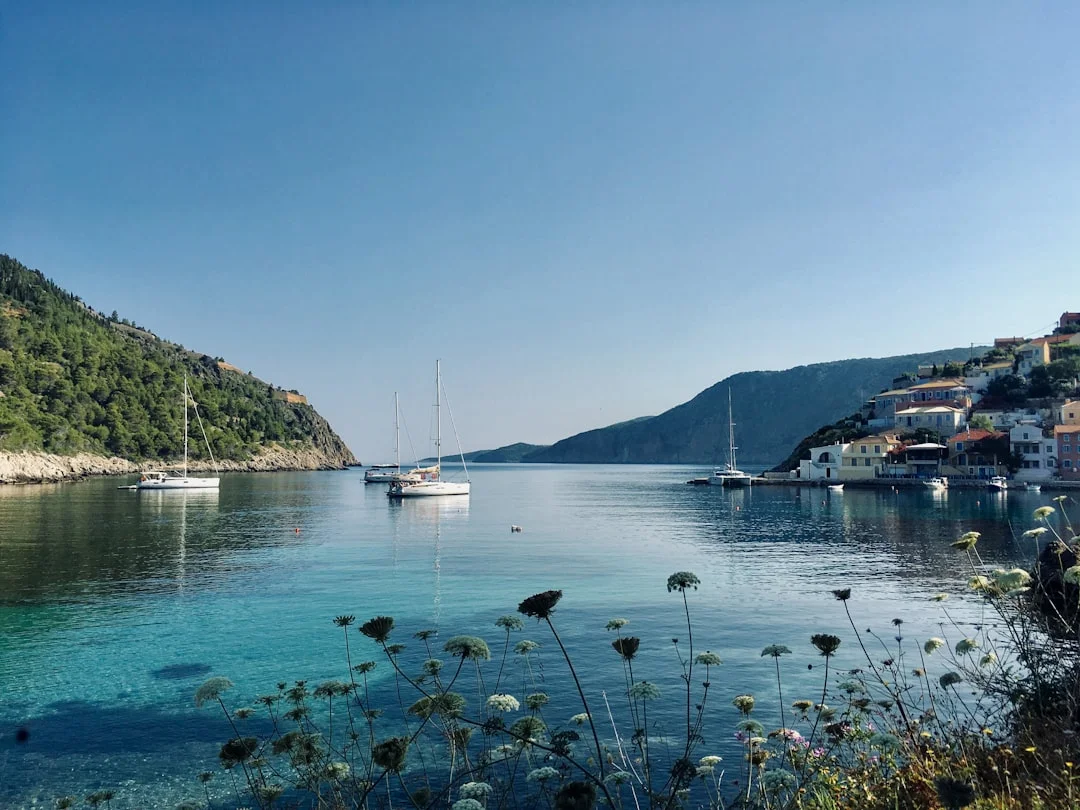
Photo by Mac McDade on Unsplash
Cyclades vs Ionian vs Dodecanese: quick decision guide
Decision criteria that actually matter afloat
Forget the lazy “Aegean vs Ionian” label and look at what you’ll feel on deck: wind strength and angle, fetch-driven chop, and harbor exposure. In the Cyclades, 15–25 kn is a normal summer day, and 25–35 kn is not rare in July–August; add current and you get that square Aegean nastiness that turns a 20 NM leg into a gym session. The Ionian’s 10–18 kn afternoon NW breeze is usually kinder, with morning calms that make close-quarters work less sporty.
Dodecanese sailing often feels like the Cyclades’ more disciplined cousin: still Meltemi-influenced, typically 15–25 kn in peak season, but with pockets where topography squeezes the wind. Those funnels can spike conditions between islands, so your plan should assume “average” wind is a lie in narrow channels.
Skill level, comfort thresholds, and passage style
Most mixed charter crews are happiest at ≤20–25 kn true—it’s enough to sail, not enough to terrify the least salty crewmember. Once the forecast shows ≥30 kn in exposed Cyclades channels, comfort drops fast because the chop goes vertical and the boat starts slamming, even when you do everything right. That’s when you choose lee-side routes, shorter legs, or you stop pretending you’re in a regatta.
Passage style matters too: the Ionian supports 10–25 NM/day with frequent bailouts and anchorages that actually hold. Cyclades and Dodecanese pacing is often 15–35 NM/day, but with earlier starts to beat the afternoon peak and to get a stern-to spot before the quay becomes musical chairs.
Crowds, infrastructure, and “plan B” flexibility
Crowds aren’t just a restaurant problem; they’re a mooring geometry problem. In peak months, expect stern-to Med-mooring, lazy lines, and competition for quay space that starts well before sunset in popular towns. The Ionian generally offers more “plan B” options within 5–10 NM, while parts of the Aegean can force a more committed crossing if you’ve chosen the wrong side of the weather window.
Use a quick tool to calculate the distance between ports to sanity-check your bailouts. If your “backup harbor” is 18 NM dead to windward in 25 kn, it’s not a backup—it's wishful thinking with paperwork.
| Region | Typical wind strength | Wave/chop feel | Skill level sweet spot | Harbor/anchorage options | Typical leg length | Crowding | Cost tendency | Best months |
|---|---|---|---|---|---|---|---|---|
| Cyclades | 15–25 kn typical; 25–35 kn frequent; ≥34 kn possible (Jul–Aug) | Short, steep Aegean chop; slamming upwind | Confident crews; reefing discipline | Some exposed quays; fewer “easy” bailouts on certain lines | 15–35 NM/day | High in Jul–Aug | Often higher in peak demand | May–Jun, Sep (Jul–Aug for wind-hunters) |
| Ionian | NW sea breeze 10–18 kn afternoons; calmer mornings | Generally lower sea state; more sheltered | First-time bareboat, families, mixed crews | Many bays/anchorages and short-hop alternates | 10–25 NM/day | High but spread out | Often best value | May–Oct (very forgiving) |
| Dodecanese | 15–25 kn peak with acceleration funnels | More open-water feel than Ionian; less brutal than central Cyclades on average | Intermediate crews; good watch-keeping habits | Mix of quays and marinas; some longer legs | 15–35 NM/day | Moderate-high | Similar to Cyclades in peak | May–Jun, Sep (Jul–Aug if routing is disciplined) |
Photo by Lisa Boonaerts on Unsplash
Winds, sea state, and local hazards by region
Cyclades: Meltemi (Etesian) mechanics and sea state
The Meltemi (Etesian) is not a cute afternoon thermal; it’s a regional pressure pattern that can run multiple days. In summer it typically blows N–NE, with 15–25 kn being common and 25–35 kn arriving often enough that you should treat it as normal in July–August. Gale-force events ≥34 kn do happen, and when they do the sea state becomes the story.
The worst surprise for visiting skippers is how fast the chop steepens. With longish fetch and wind-against-sea moments, the Aegean stacks up short and sharp, so a boat that’s fine at 6.5 kn under power in flat water may be reduced to uncomfortable bashing and higher fuel burn. Your schedule should assume earlier departures and earlier arrivals, not heroic “we’ll see” afternoons.
Ionian: sea-breeze pattern, morning calms, and squalls
The Ionian summer rhythm is usually predictable: calmer mornings for coffee, docking, and unforced errors, then a building NW sea breeze of 10–18 kn in the afternoon. That’s enough to sail properly without the whole boat turning into a percussion instrument. It also means you can plan close-quarters work before lunch and let the breeze show up after you’ve cleared the harbor.
Local squalls and gusts still appear, especially around headlands and in constricted channels where the breeze accelerates. But the sea state is generally more forgiving because many legs can be kept in the lee, and you can shorten the day to 5–10 NM without sacrificing the whole itinerary.
Dodecanese: moderated Meltemi and acceleration funnels
The Dodecanese sits in the SE Aegean and still feels the Meltemi, typically 15–25 kn in peak season, often slightly moderated versus the central Cyclades. The trade is that the geography creates funnels: between islands, around capes, and across gaps where the wind can add 10 kn in a few boat lengths. If your crew is already tense, that’s where mistakes happen.
Your routing should think in wind angles. Persistent northerlies can turn an innocent-looking direct line into an upwind slog; a reaching or downwind sequence often makes the same miles feel half as hard. Use GRIBs as guidance, but cross-check with the official HNMS forecast and local observations.
Gusts, katabatics, and ferry traffic: what surprises crews
Katabatic bursts off high terrain can hit bays that look calm on a chart. A harbor entrance can go from 12 kn apparent to 25+ kn in a gust line, right when you’re reverse-driving stern-to with an audience. Keep a reefable plan even on “easy” days, and brief the crew on what a gust looks like before it arrives.
Ferries are the other Greek constant: fast, heavy, and on schedule. COLREGS apply, but don’t expect a high-speed ferry at 25–35 knots to do you favors because you’re on vacation. Keep AIS on, maintain a proper lookout, and assume fishing floats and floating lines near quays are plotting against your propeller.
Tip (comfort rule that saves holidays): If the forecast shows ≥30 kn across an exposed Cyclades channel, treat it as a “lee route or lay day” trigger. Most charter crews stay happier at ≤20–25 kn, and happy crews break fewer things.
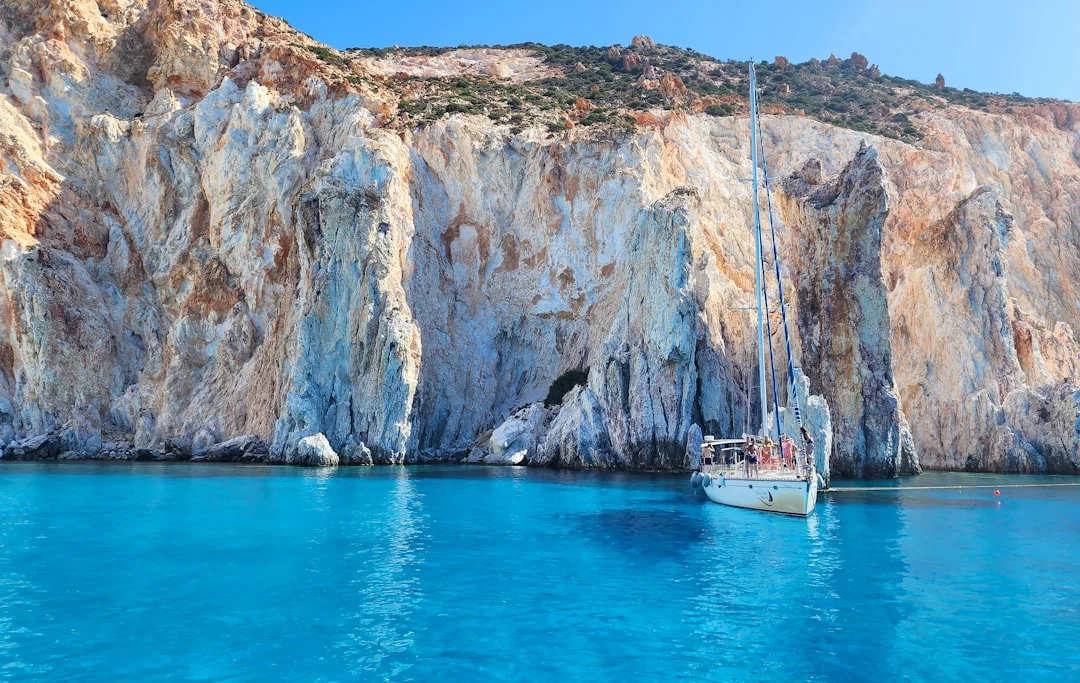
Photo by Derek Nielsen on Unsplash
Best 7-day Cyclades itinerary: route, legs, bailouts
Base choice: Lavrion vs Paros/Mykonos-style starts
For Cyclades island-hopping, Lavrion is a practical mainland base: you can do a short shakedown leg and you’re not immediately committed to a long exposed crossing. Starting in Paros or Mykonos can shorten your “first day logistics,” but it often comes with higher peak-season pressure and fewer easy bailouts if the Meltemi shows up early. Either way, plan the first 24 hours as training, not as a record attempt.
A 36–41 ft charter mono typically motors at 6–7.5 kn, but in Aegean chop your average can drop. I use 6.5 kn as a conservative planning speed, then I add time for reefing, tacking angles, and harbor delays. Breezada’s sea distance calculator helps you verify the NM quickly when you’re sketching options with a crew staring at you.
Numeric route planner: NM, hours underway, timing
Here’s a realistic 7-day loop that respects early starts and quay scarcity, with approximate legs. Keep daily targets in the 15–35 NM range, and try to be moored by mid-afternoon when July–August winds peak.
- Day 1: Lavrion → Kea (12–15 NM, ~2–2.5 hr at 6.5 kn)
- Day 2: Kea → Syros (about 20–30 NM, ~3–5 hr)
- Day 3: Syros → Mykonos (15–20 NM, ~2.5–3 hr)
- Day 4: Mykonos → Paros (20–25 NM, ~3–4 hr)
- Day 5: Paros → Naxos (10–15 NM, ~1.5–2.5 hr)
- Day 6: Naxos → Kea or Kythnos (often 25–35 NM, ~4–6 hr)
- Day 7: Back to Lavrion (typically 15–25 NM, ~2.5–4 hr)
Those hours are “wheel-turning” estimates, not the time you’ll tell your crew. Add another 30–60 minutes per day for sail handling, traffic, and the inevitable “where is the lazy line pickup?” choreography.
Heavy-wind alternatives and safe harbors
When the Meltemi is forecast ≥30 kn, reduce exposure rather than grit your teeth through it. Plan B can be as simple as staying on the lee side of a bigger island, shortening the leg to 10–15 NM, or doing a rest day that saves energy and reduces risk. In the Cyclades, a smart lay day often preserves the rest of the week.
Build at least two alternates into your week on day one. If you can’t name them and measure them in NM, you don’t have alternates—you have hope. Use a sea distance calculator for route planning to confirm bailout distances and to estimate fuel if you end up motoring into wind and chop.
Sail handling notes for 25–35 kn and chop
Treat 25–35 kn spells as routine in July–August. On a typical charter sloop, that means a smaller headsail (or partially furled genoa with a proper lead), and 1–2 reefs earlier than you’d take in lighter venues. Reef early while the deck is calm; the “I’ll do it later” plan usually happens at the worst moment, because the sea has a sense of humor.
Approaching crowded harbors, assume floating lines near the quay and lazy lines under tension. Keep someone on the bow watching for line angles, keep the boat speed minimal, and brief the crew to never put hands or feet between stern and quay. Gelcoat repairs are expensive, and dignity is rarely refundable.
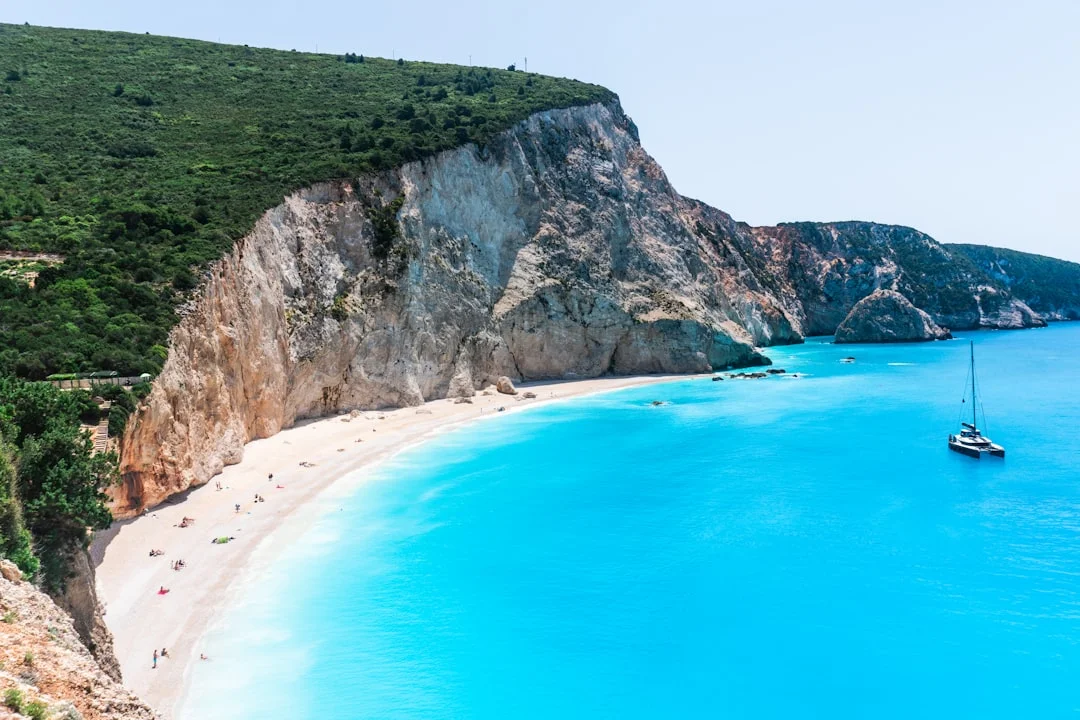
Photo by Johnny Africa on Unsplash
Best 7-day Ionian sailing route: short hops, shelter
Corfu vs Lefkas departures: what changes
Corfu gives you immediate access to Paxos/Antipaxos and the north Ionian, with plenty of services and a busy summer scene. Lefkas is the classic “short-hops all week” base: you can be in sheltered water quickly, and it’s easier to build a route with 5–15 NM legs for crews that want more swimming and fewer miles. Both work, but choose based on whether you want one longer open-water day or a steady rhythm.
The Ionian’s summer pattern of 10–18 kn NW afternoons means you can plan easy mornings for undocking and then sail when the breeze fills. It’s a friendly place to practice reefing, anchoring, and general boat handling without the Aegean punishing every mistake.
Family-friendly legs and anchoring rhythm
A practical 7-day Ionian outline from Corfu might look like this, with one longer day and several relaxed ones. Distances vary by exact anchorage choice, but the pacing stays in the 10–25 NM/day comfort zone.
- Day 1: Corfu → Gouvia shakeout or nearby bay (5–10 NM)
- Day 2: Corfu → Paxos (25–30 NM)
- Day 3: Paxos → Antipaxos or nearby bays (5–10 NM)
- Day 4: Paxos → Mainland anchorage (often 10–20 NM)
- Day 5: Short hop to a new bay (5–12 NM)
- Day 6: Return north in stages (15–25 NM)
- Day 7: Back to Corfu base (10–20 NM)
Anchoring is the Ionian skill that matters most. Many bays are sand with weed patches, so you’ll want a positive set and a diver check when visibility allows, especially if the breeze comes up to the top end of the 10–18 kn range.
Channel gusts, traffic, and afternoon timing
Gusts do happen in narrows and around headlands, and day-boat traffic spikes near popular towns. Plan arrivals before late afternoon if you want quay space, but don’t treat it like a Cyclades race; the Ionian’s big advantage is that there’s usually another bay within 3–8 NM if things look crowded. That “plan B within 30–60 minutes” is what keeps families happy.
Near crowded swimming bays, watch for swimming lines and floating hazards. A dinghy outboard is often gasoline, so even if the main yacht is diesel, follow good practice when transferring or storing fuel—ABYC H-24/H-25 are a solid reference mindset for not doing anything clever.
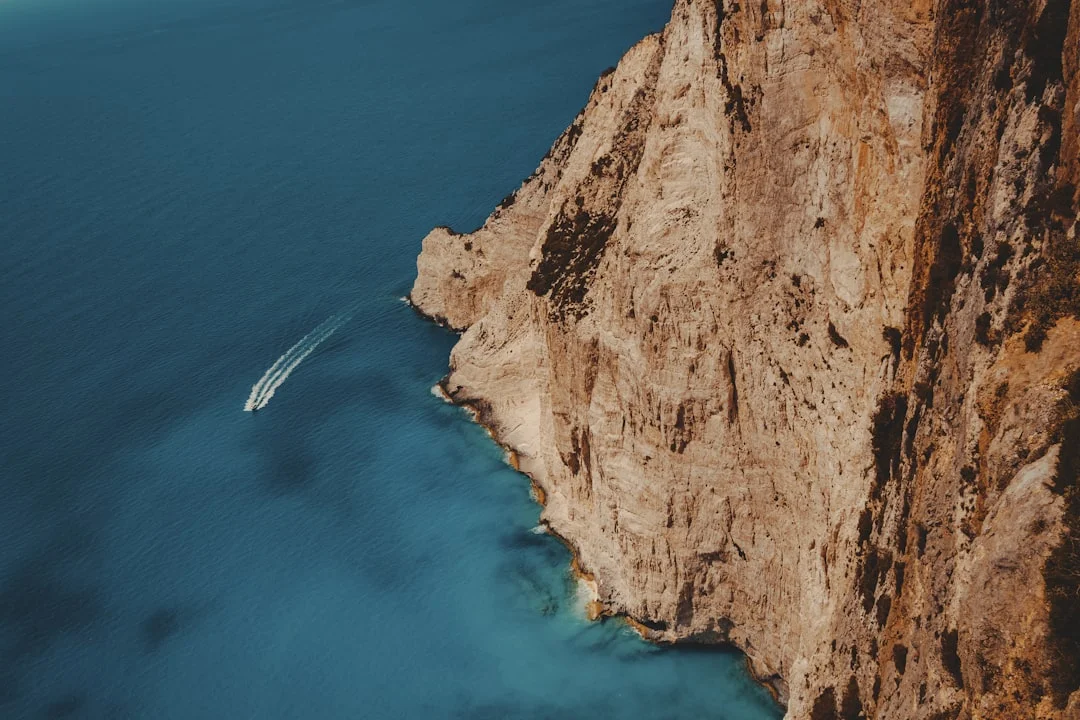
Photo by Michael Pointner on Unsplash
Best 7-day Dodecanese itinerary: Kos/Rhodes options
Base choice and passage geometry in the SE Aegean
Kos and Rhodes are the usual Dodecanese starters, and they feel more “marina-based” than many Cyclades towns. The Dodecanese is Meltemi-influenced, so expect 15–25 kn in peak season, but you often get better route geometry options—more chances to choose a reach instead of a beat. That said, distance planning matters because some crossings are simply longer and more exposed.
Your boat choice matters here, too. Many charter yachts carry CE categories under ISO 12217 and the RCD 2013/53/EU framework; a Category A/B boat is built with more offshore margin than a C. You still sail the conditions you have, but it’s wise to know what you’re standing on.
Island-to-island legs and wind-angle strategy
A practical 7-day route from Kos can keep legs manageable while giving you real Aegean sailing. Use the Meltemi direction to favor reaching legs when you can, and avoid stacking too many hard upwind days back-to-back.
- Day 1: Kos → Kalymnos (10–12 NM)
- Day 2: Kalymnos → Leros (often 15–25 NM)
- Day 3: Leros → Lipsi or nearby stop (10–20 NM)
- Day 4: Explore locally (5–15 NM) and rest the crew
- Day 5: Longer leg option (about 25–35 NM) if forecast is stable
- Day 6: Work back toward Kos in stages (15–30 NM)
- Day 7: Return to base (10–20 NM)
If you start from Rhodes instead, plan for a slightly more “big island + open water” flavor, and be honest about the crew’s appetite for time underway. At 6.5 kn, 30 NM is roughly 4.5 hours, and it won’t feel shorter when it’s on the nose.
Longer passages, exposure, and contingency stops
In the Dodecanese, I like to build one weather day buffer when forecasts trend >25 kn for multiple days. That buffer is what lets you wait for a cleaner sea state rather than pounding into it and arriving exhausted. It also helps with berth competition in marinas, where services are great but space can vanish quickly in high season.
When winds accelerate in funnels, reef before the funnel, not inside it. Crew safety is simple stuff: clipped-on on the foredeck when it’s bouncy, conservative helming, and limiting fatigue. A week is long enough to accumulate tired decisions, and tired decisions love boat hooks and gelcoat.
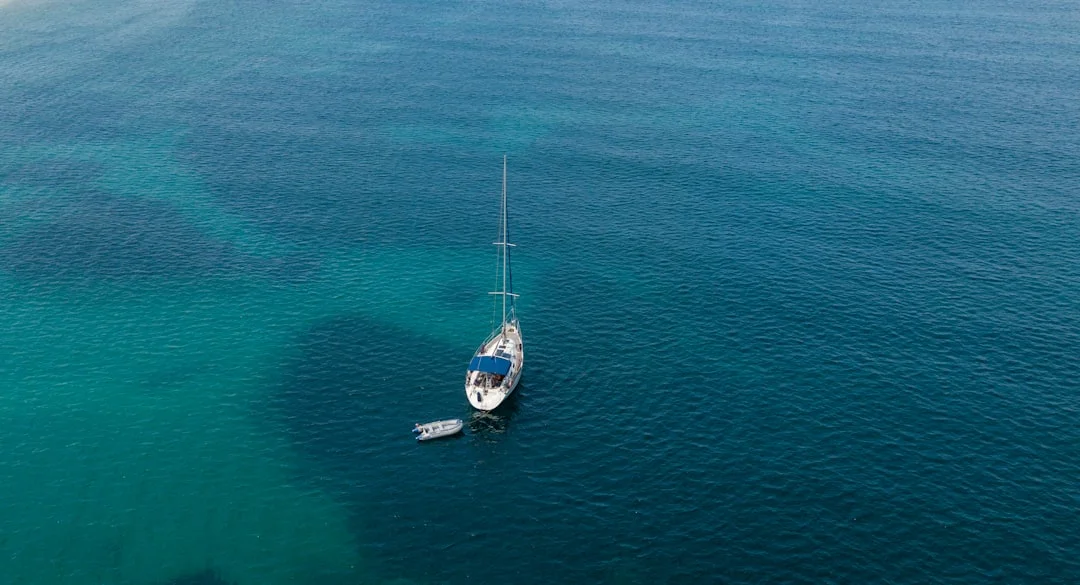
Photo by manos koutras on Unsplash
Costs and budgeting: real totals for 4–8 sailors
Charter price bands by season (mono vs cat)
For a modern 36–41 ft (3-cabin) monohull, bareboat weekly rates are typically €2,000–€3,200 (Apr/Oct), €3,200–€5,500 (May/Jun/Sep), and €5,000–€8,000+ (Jul/Aug). Catamarans in the 40–45 ft bracket often run €4,500–€12,000+, and that price jump is not subtle when split among four people. If you’re cost-sensitive, either add crew numbers or reduce peak-season ambitions.
Don’t ignore add-ons: final cleaning €150–€250, outboard €80–€150/week, SUP €100–€200/week, Wi‑Fi €40–€80/week, and safety net €150–€250/week. Those “little” extras can add €400–€900 before you’ve even left the dock.
Skipper/hostess, deposits, and damage waivers
A skipper typically costs €180–€250/day + food, and a hostess/cook €150–€220/day + food. That can be excellent value for mixed-experience crews, especially in the Cyclades, where local knowledge pays back in stress reduction and fewer docking incidents. The cheapest skipper is the one who prevents a prop wrap in a lazy line field.
Security deposits are commonly €2,000–€4,000 for 35–45 ft monohulls, with newer/larger boats at €4,000–€8,000. Damage waivers often run €200–€450/week with a residual, and they change cashflow and risk tolerance more than they change seamanship.
Fuel, mooring fees, and provisioning assumptions
Fuel planning is straightforward: many charter auxiliaries burn 3–6 L/hr, and a realistic week uses 10–25 engine hours depending on wind and itinerary. Diesel at €1.70–€2.20/L means your fuel line item often lands somewhere between “fine” and “why are we motoring again?” Headwinds in the Cyclades usually push you toward the high end.
Mooring fees are often cheaper than the Western Med, but not free. Town quays might be €5–€20/night for 35–45 ft, while larger marinas can be €30–€80/night depending on services and season. Provisioning varies wildly, but €25–€45 per person/day is a decent mid-range planning number if you mix onboard meals with a few tavernas.
One-way charters: when they pencil out
One-way charters exist, but they’re operationally constrained. Fees commonly run €300–€900+, and you’re paying for staffing, base logistics, schedule disruption, and sometimes an extra check-in/out reshuffle. They can be worth it if a one-way saves you a 30–50 NM backtrack or if it converts a hard upwind return into a reach, but availability is the limiting factor.
| Scenario (6 people, 7 nights) | Major inclusions | Typical total range (€) | Approx €/person |
|---|---|---|---|
| Bareboat, 36–41 ft mono | Charter €3,200–€5,500 (shoulder), add-ons €400–€900, moorings €50–€300 (mix), fuel €50–€330 (see assumptions), provisioning €1,050–€1,890 | €4,750–€8,920 | €790–€1,485 |
| Skippered, 36–41 ft mono | Bareboat package above + skipper €1,260–€1,750 (7 days) + skipper food (often €150–€€300 depending on crew habits) | €6,160–€10,970 | €1,025–€1,830 |
Fuel assumptions used above: 3–6 L/hr, 10–25 hrs/week, €1.70–€2.20/L. Use this tool to estimate your fuel needs based on the voyage distance to estimate motoring hours from your route NM if you’re expecting headwinds or tight check-in timing.
Mooring, anchoring, and compliance: Greece-specific seamanship
Med-moor stern-to with lazy lines: technique and prep
Greek town quays are usually stern-to Med-mooring, often with lazy lines rather than dropping your own anchor in a crowded spaghetti bowl. Depth at the wall is commonly 2.5–5+ m, and the “anchor drop zone” for those who must anchor can be 20–40 m out, depending on harbor geometry. The trick is not strength; it’s sequencing and crew briefing.
Prep before you enter: fenders down on both sides, two stern lines ready, and a boat hook staged for the lazy line. In reverse, keep speed minimal and steer with prop wash, then get stern lines on first so you can stop the boat and work the lazy line without drifting sideways into your neighbor’s pride and joy.
Anchoring setup, scope, and holding in Meltemi
Charter ground tackle is usually adequate if you treat it seriously: an anchor around 16–25 kg, 8–10 mm chain, and 50–80 m of it. For a windy night in 20–30 kn, I plan scope in the 4:1 to 7:1 range depending on depth, swing room, and whether the harbor is full of other anchors set by optimists. If you’re in 5 m and you only put out 20 m of chain, you’re not anchored—you’re paused.
In the Aegean, katabatics and gusts can test a marginal set. Back down firmly, confirm you’re not dragging, and avoid anchoring where the seabed is unknown or cluttered when you have alternatives. A night of dragging is a long night, and it’s even longer when you’re explaining it at check-out.
Port police paperwork and onboard safety standards
Most charters handle the admin, but it pays to know the vocabulary: the limenarcheio (port police) and documents like DEKPA may come up depending on boat status and cruising area. Keep passports/IDs, charter papers, and boat documents organized, because the only thing worse than paperwork is wet paperwork.
Safety-wise, think in standards, not superstition. COLREGS are not optional, SOLAS V is a good voyage-planning mindset even for coastal hops, and your boat’s CE category under ISO 12217 (per the RCD 2013/53/EU) is worth checking before you sign. For onboard systems, ISO 9094 (fire) and ISO 10133/13297 (electrical) are the reason you don’t overload shore power with every gadget at once, and ABYC A-1/H-33 are good reference habits for LPG and diesel handling.
When to go: month-by-month timing for wind, value, crowding
Shoulder season (May–Jun, Sep): the sweet spot explained
If you ask me for one answer, it’s this: May–June and September deliver the best balance for most crews. Water and air are comfortable, crowds are lower, and the odds of prolonged strong Cyclades Meltemi are typically lower than in July–August. Prices also sit closer to the €3,200–€5,500 shoulder band for that 36–41 ft monohull, rather than the €5,000–€8,000+ peak sting.
These months also give you more berth flexibility. Showing up an hour later than planned is less likely to become a crisis, and your “plan B harbor” actually has space. That alone is worth a lot in reduced stress and fewer rushed docking attempts.
Peak summer (Jul–Aug): managing Meltemi and marinas
July–August is when the Cyclades earns its reputation: multi-day 25–35 kn spells are very plausible, and ≥34 kn events can happen. The right response is not fear; it’s structure—early departures, conservative sail plans, and realistic daily runs. In Cyclades/Dodecanese, assume 15–35 NM/day and try to be tied up before the afternoon peak and the evening quay scramble.
Heat management becomes seamanship too. If you plan a 4–6 hour bouncy passage and then attempt a stern-to in a crosswind at 1700 with the crew fried, you’re stacking risks. The Ionian stays approachable in peak because its 10–18 kn pattern and shelter options reduce the penalty for being human.
Early/late edges (Apr, Oct): comfort tradeoffs and deals
April and October can be great value—often €2,000–€3,200/week for that mid-size monohull—but you trade for cooler water, shorter days, and more variability. Some smaller ports reduce services, and a “quick” repair or resupply can take longer. If you’re comfortable wearing a light layer at night and you’re not chasing beach-club energy, it can be excellent sailing.
Region choice matters more at the edges. The Ionian remains forgiving, while the Cyclades can still throw hard days, just with fewer crowds to cushion your mistakes. Plan conservatively, and let the weather pick the route, not the other way around.
Frequently Asked Questions
For a 36–41 ft monohull averaging 6.5 kn, how many hours underway should I plan for a 25 NM Aegean leg when factoring reefing, leeway, and harbor maneuvering time?
At 6.5 kn, 25 NM is about 3.8 hours of pure distance-running (25 ÷ 6.5). In the Aegean, plan closer to 4.5–5.5 hours total once you add reefing, higher tacking angles/leeway upwind, ferry avoidance, and 30–60 minutes for harbor approach, lazy lines, and waiting your turn.
What reefing plan (reef points and headsail size) is practical for 25–35 kn Meltemi on a typical charter sloop, and at what forecast threshold (kn) should crews avoid exposed Cyclades channels?
For 25–35 kn, a practical charter setup is 1–2 reefs in the main and a reduced headsail (partially furled genoa with a decent lead, or a smaller jib if available). Reef earlier than you think, because the Aegean chop punishes late decisions. Many skippers keep mixed crews comfortable at ≤20–25 kn, and avoid exposed Cyclades channels when the forecast is ≥30 kn, especially if the route is hard on the wind.
How do Greek lazy lines differ from picking up a bow-to mooring, and what minimum stern-line lengths and fender placement work best for 2.5–5 m quay depths?
With Greek lazy lines you’re typically stern-to the quay, and the “front end” of your boat is held by a line that runs to a seabed attachment, not by your anchor. You secure the stern lines first, then pick up and tension the lazy line to control bow position and keep clear of neighbors’ anchors/propellers. For quay depths of 2.5–5 m, have stern lines long enough to stand off the wall—at least 12–15 m each is a practical minimum on a 36–41 footer—and rig fenders low and numerous because the quay edge is rarely forgiving.
What fuel budget results from 3–6 L/hr consumption and 10–25 engine hours/week at €1.70–€2.20/L, and how does that change between Cyclades headwinds vs Ionian sea-breeze sailing?
Weekly fuel volume is 30–150 L (3×10 to 6×25). At €1.70–€2.20/L, that’s roughly €51–€330. Cyclades headwinds and chop often push you toward more motoring and higher RPM, while the Ionian’s 10–18 kn sea breeze and sheltered legs can reduce engine hours if you’re willing to sail when the wind arrives.
What are realistic one-way yacht charter fees (€300–€900+) covering, and how do distance, base staffing, and check-in/out constraints affect availability between Aegean areas?
That €300–€900+ typically covers staff time, paperwork, base logistics, and the disruption of having a yacht finish away from where the operator needs it for the next charter. Availability depends less on distance than on schedule geometry: fixed check-in/out days, maintenance cycles, and whether the operator has staff and support at both ends. Between Aegean areas, one-ways can be limited in peak season because fleets are tightly booked and repositioning slots are scarce.
About the Author
Related Articles
Amalfi Coast vs French Riviera Sailing Guide (Costs & Routes)
Compare Amalfi Coast vs French Riviera sailing—costs, crowds, mooring rules, best months, and 7-day routes. Choose your coast and plan now.
By Breezada Team
Puget Sound Cruising Guide to Gulf Islands Routes
Plan routes, anchorages, and weather windows with this Puget Sound cruising guide for the Gulf Islands & San Juans. Read now and start plotting.
By Breezada Team
Sailing Amalfi Coast Guide: Ports, Anchorages & Rules
Sailing Amalfi Coast guide to Capri, Positano & Amalfi: best ports, anchorages, fees, VHF and rules. Plan your route—read now.
By Breezada Team
Dry Tortugas Sailing: Routes, Anchoring & Permits
Plan Dry Tortugas sailing from Key West with routes, weather windows, anchoring/moorings, and permits. Read the guide and plan your trip.
By Breezada Team