Tips for Sailing a Catamaran: What's Different from Monohulls

Sailing a catamaran for the first time after years on monohulls is a bit like switching from a sports car to a wide-body truck — the physics change, the reflexes need recalibrating, and some things that used to be hard become laughably easy. Whether you're chartering a 40-foot cruising cat in the Caribbean or considering buying one for bluewater passage-making, understanding how catamarans behave differently will save you from embarrassing dock approaches, unnecessary anxiety in heavy weather, and a few arguments with your crew.

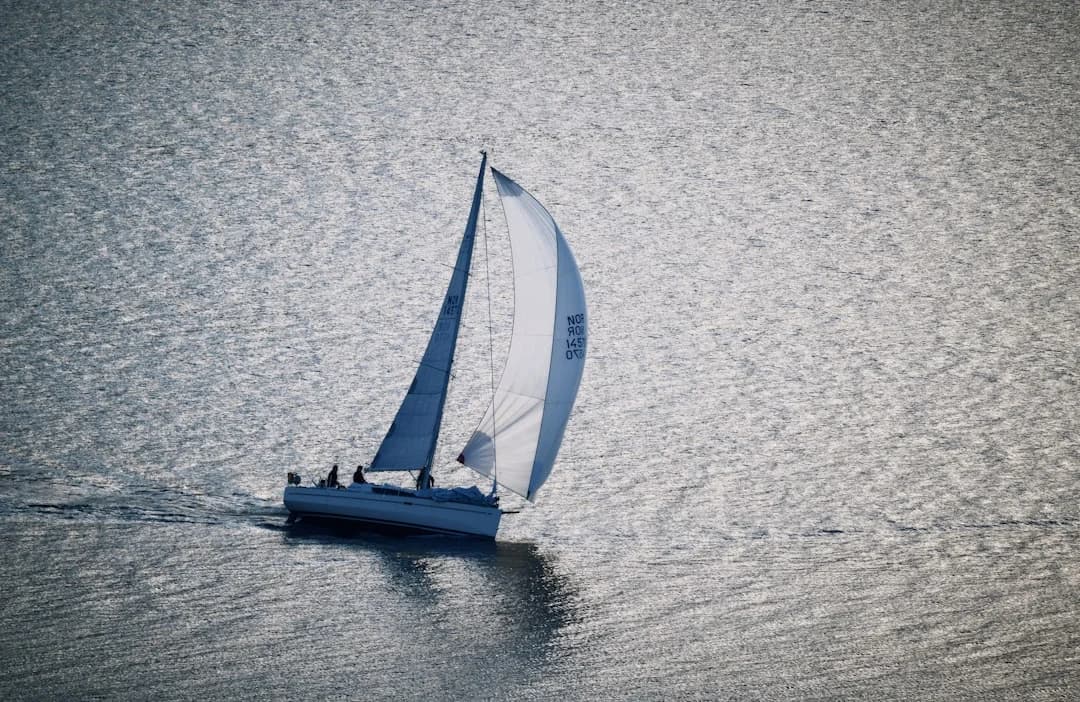
Photo by Karla Car on Unsplash
Stability: The First Thing You'll Notice
Step aboard a catamaran and the first revelation is that it doesn't heel. On a monohull, 15-20 degrees of heel is a normal Tuesday. On a cruising catamaran, you might see 5 degrees in a strong gust — and your coffee stays in the cup.
This stability comes from beam width. A typical 40-foot cruising cat has a beam of 22-24 feet, compared to around 13 feet on a monohull of the same length. That wide stance means enormous initial stability. The tradeoff is that a catamaran doesn't have a weighted keel pulling it back upright — so while it resists heeling far more than a monohull, if you ever did manage to push it past its stability limit, it won't self-right. In practice, modern cruising catamarans are designed with enough buoyancy and stability margins that capsizing requires genuinely extreme conditions combined with poor seamanship.
For crew comfort, flat sailing changes everything. Cooking underway becomes manageable. Moving around the boat doesn't require handholds at every step. Seasickness drops dramatically. I've seen confirmed "I don't do boats" passengers spend a week on a catamaran without trouble.
Sail Handling: Less Drama, Different Technique
Catamaran sail handling is generally simpler than on a monohull, but the reasons why you trim differently matter.
Apparent wind shifts less. Because a catamaran doesn't heel, the apparent wind angle stays more consistent. On a monohull, heeling changes the apparent wind — you're constantly adjusting. On a cat, once you've trimmed for the conditions, adjustments are smaller and less frequent.
Reefing earlier is essential. This is the single most important sailing catamaran tip: reef before you think you need to. A monohull bleeds excess wind energy by heeling. A catamaran has nowhere to dump that energy except into speed and structural load on the rig. When a gust hits a monohull, the boat leans and the sails depower naturally. When a gust hits a catamaran, the load goes straight into the rigging, the bridgedeck, and the hulls. Most catamaran manufacturers recommend reefing at 15-18 knots of true wind, well before a monohull sailor would even think about it.
Pointing ability is different. Catamarans generally don't point as high as monohulls. Where a well-trimmed monohull might manage 35-40 degrees to the true wind, a cruising catamaran typically does 45-55 degrees. The good news? What you lose in pointing, you make up in speed through the water. A catamaran tacking through 100 degrees still covers ground faster than a monohull tacking through 80 degrees because the boat speed is significantly higher. If you're planning a passage with upwind legs, you can calculate the distance between waypoints to see whether the extra tacking distance matters for your timeline.
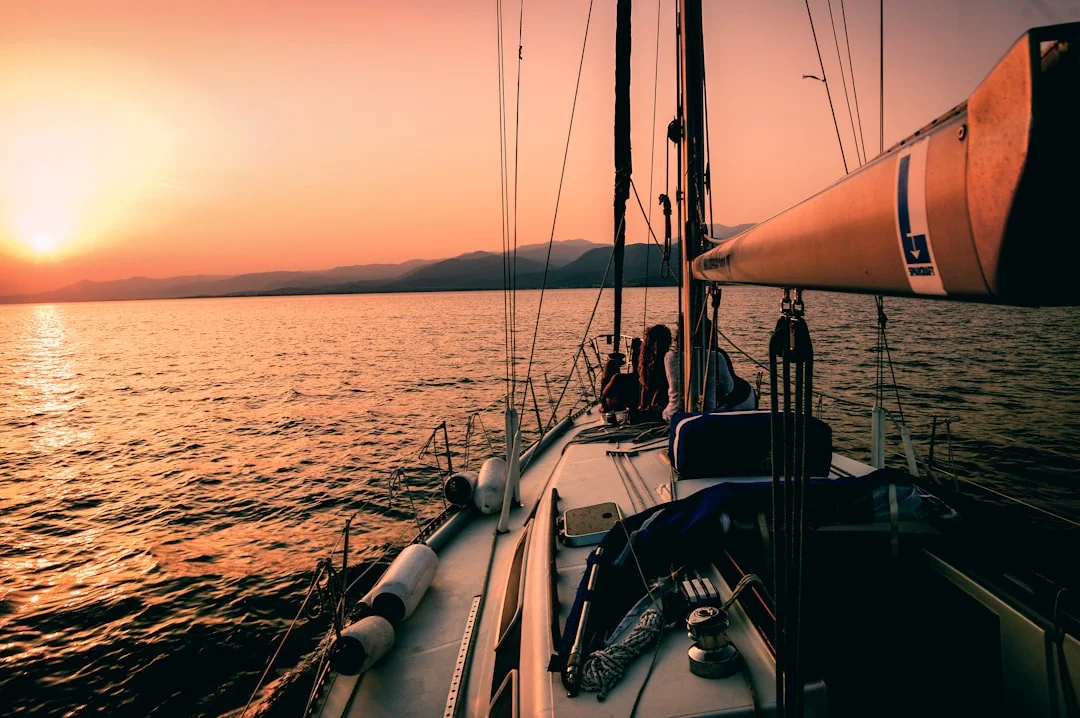
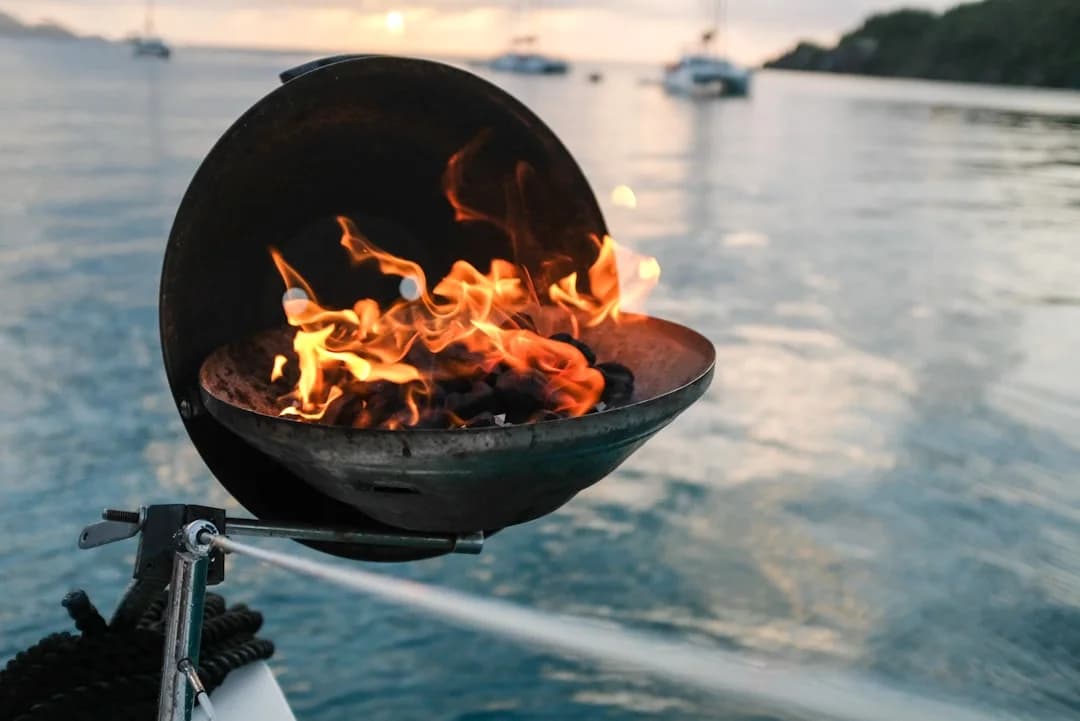
Photo by Markos Mant on Unsplash
Docking and Maneuvering: Twin Engines Change Everything
This is where catamaran sailing gets genuinely fun. Most cruising catamarans have two engines, one in each hull, and this gives you a superpower that monohull sailors can only dream of: you can spin the boat in its own length.
Differential thrust is the technique. Push the port engine forward and the starboard engine into reverse (or vice versa), and the boat pivots on the spot. No bow thruster needed. No spring lines for a kick turn. No panic. The pivot point is right between the two engines, so you get precise, predictable rotation.
For a typical marina approach:
- Come in slowly — catamarans have significant windage, so momentum management matters
- Line up your approach, accounting for the fact that your beam is twice what you're used to
- Use differential thrust to make final adjustments
- Remember: a catamaran stops differently. Without a deep keel creating drag, the boat can carry momentum longer in calm conditions — but also gets pushed sideways by wind more easily
The windage factor is critical. A catamaran's high bridgedeck and wide profile catch wind like a billboard. In strong crosswinds, always approach into the wind if you can. If you're docking downwind in 20 knots, you're going to have a bad time. We've covered docking in depth in our step-by-step guide to docking a sailboat — the fundamentals apply, but the twin-engine techniques make a catamaran uniquely maneuverable at close quarters.
Tight spaces require awareness. Your turning circle might be zero (spinning in place), but your beam means you need wider fairways. Check marina dimensions before booking. Some older Mediterranean marinas with narrow finger pontoons simply won't fit a 40-foot catamaran comfortably.
Speed and Performance Characteristics
Catamarans are faster than monohulls of similar length — often 20-30% faster on a reach. The reasons are straightforward: less wetted surface area relative to displacement, no energy lost to heeling, and two narrow hulls create less wave-making resistance than one wide one.
On a beam reach in 15 knots of true wind, a 40-foot cruising catamaran will comfortably do 8-9 knots. The same conditions might give a 40-foot monohull 6-7 knots. The difference adds up. Over a 500 nm passage, that's potentially a full day saved.
But speed comes with caveats:
- Upwind performance drops off. The speed advantage shrinks going to windward, and the wider tacking angles mean more distance sailed.
- Light air is a weakness. Without the weight of a keel, catamarans can feel sluggish in very light winds (under 8 knots). Many cruising cat owners motor more often in light conditions.
- Surfing in following seas. Catamarans can accelerate dramatically when surfing downwind. This sounds great until you're doing 14 knots on a wave and the autopilot is struggling to keep up.
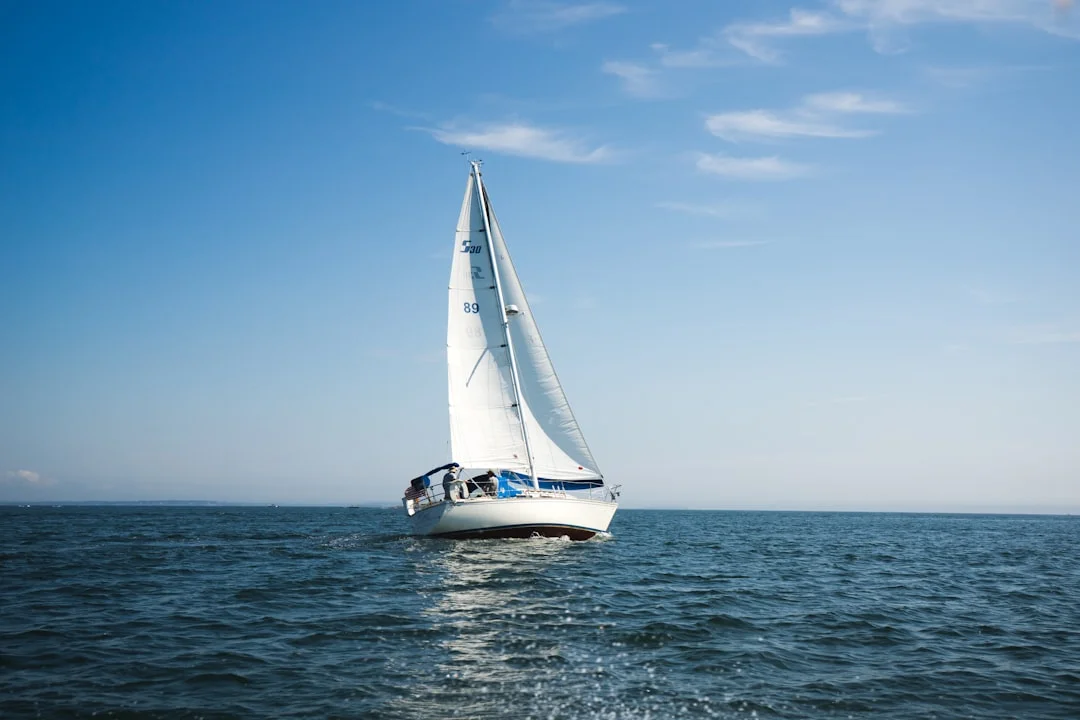
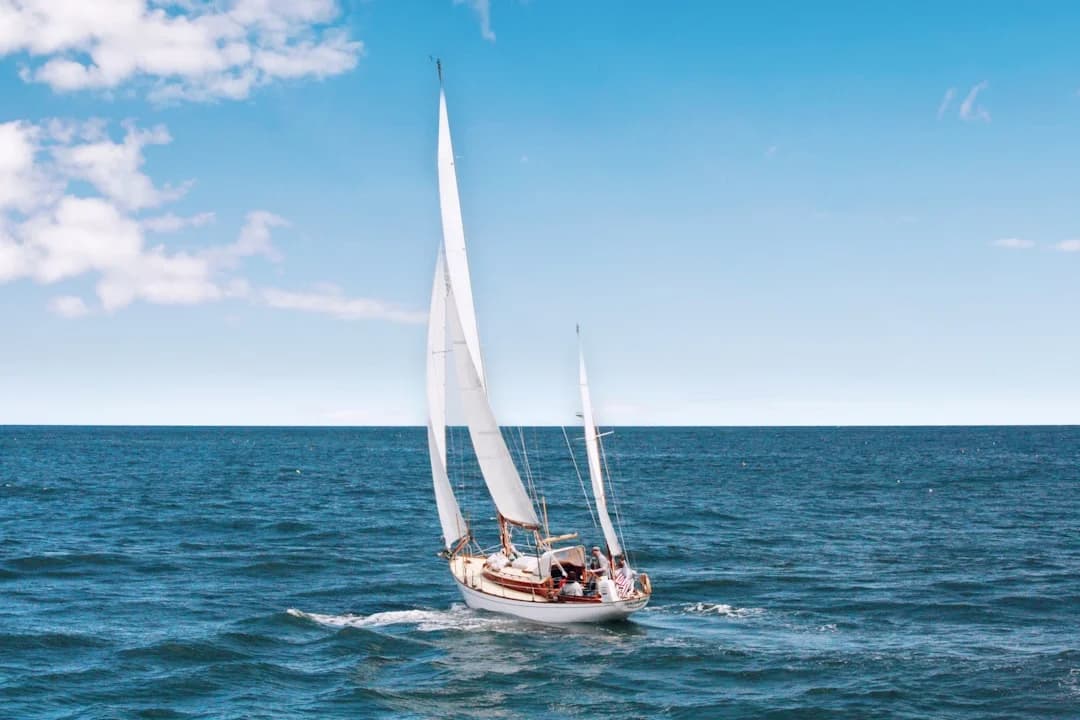
Photo by Evan Smogor on Unsplash
Anchoring: Shallow Water Freedom
Catamarans draw significantly less water than monohulls. A 40-foot cruising cat typically draws 3.5-4.5 feet with keels (or as little as 2.5 feet with daggerboards raised), compared to 6-7 feet for a monohull of the same size. This opens up an entirely different world of anchorages.
Shallow bays that monohulls have to skip? You're in. Close to the beach in the Bahamas where the water is 4 feet over sand? No problem. That gorgeous cove in the Greek islands where the chart shows 1.5 meters? Anchoring there while the monohulls sit outside. Use Breezada's sea distance calculator to plan routes that take advantage of these shallow-water anchorages along your path.
Anchoring technique adjustments:
- Set the bridle. Catamarans anchor using a bridle — a Y-shaped line running from both bows to the anchor chain. This prevents the boat from sailing at anchor (which the wide beam encourages) and reduces the load on the windlass.
- Scope calculations change. With less draft, your scope ratio (chain length to depth) might need to increase slightly, since the pull angle on the anchor is flatter.
- Wind riding behavior is different. A catamaran at anchor swings differently than a monohull. The wide beam and high windage mean the boat tends to lie more consistently to the wind, but can also generate more snatch loads in gusty conditions. A good quality snubber is essential.
Bridgedeck Clearance and Slamming
One catamaran-specific phenomenon that catches first-timers off guard is bridgedeck slamming. The bridgedeck is the underside of the structure connecting the two hulls. When sailing into a chop, waves can hit the underside of this bridge with surprising force, creating loud bangs and vibrations.
It sounds alarming. It's usually not dangerous — but it is uncomfortable, and it stresses the structure over time. Higher-end catamarans have more bridgedeck clearance to reduce slamming. Budget cats with lower clearance will slam more often.
How to manage it:
- Reduce speed in steep, short chop
- Sail slightly off the wind rather than dead into it
- If it's persistent, reef down to reduce speed and impact force
- Accept that some slamming is normal and the boat is designed for it
Heavy Weather Handling
Heavy weather on a catamaran is a different experience than on a monohull. The good news: you're on a stable, wide platform that doesn't roll. The concerning news: the tactics differ, and monohull instincts can be wrong.
Speed management is critical. A catamaran's worst enemy in heavy weather is going too fast. Unlike a monohull that naturally slows as it heels, a catamaran will keep accelerating. Excessive speed downwind can lead to pitchpoling (the bows dig in and the stern lifts). The standard advice: keep speed below 12-15 knots in rough following seas by reducing sail area aggressively.
Heaving to works differently. On a monohull, heaving to with a backed jib creates a comfortable drifting state. On a catamaran, heaving to is less effective because there's no keel to provide lateral resistance. Some catamaran sailors use a drogue or series drogue instead for storm management. For an in-depth look at the broader differences in handling between the two hull types, our monohull vs catamaran comparison covers the structural and performance tradeoffs in detail.
Beam seas are more comfortable. This is one area where catamarans genuinely shine in bad weather. A monohull in beam seas rolls miserably. A catamaran stays relatively flat. If you're caught in weather and can choose your angle, beam-on is far more comfortable on a cat than on a monohull.
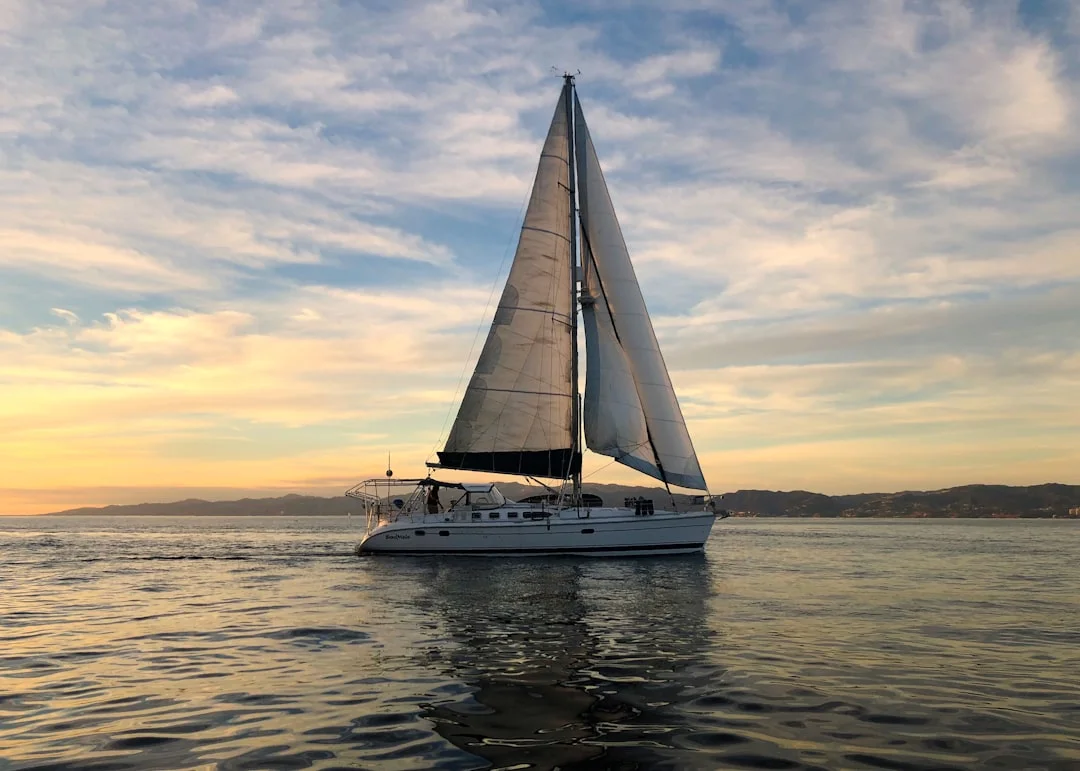
Photo by Alix Greenman on Unsplash
Living Aboard: Space and Layout
The living space on a catamaran is in a different league. A 40-foot catamaran offers roughly the interior volume of a 50-55-foot monohull. Four cabins with en-suite heads is standard. The saloon is at deck level with panoramic views. The galley is full-sized — not the narrow corridor-style galley of a monohull.
Practical differences for daily life:
- The saloon stays level. Cooking, eating, and working at the nav station are all done on a flat surface. This alone converts many monohull sailors.
- Cabins are in the hulls. Each hull typically has a forward and aft cabin. The forward cabins can experience more motion, especially in a seaway. The aft cabins are usually closer to the waterline and can feel warmer.
- Engine access is separated. Each engine lives in its own hull, which means better access for maintenance — but also means carrying spares for two engines instead of one.
- Storage is distributed. Rather than one deep bilge, a catamaran has two shallow bilges and numerous lockers spread across both hulls and the bridgedeck. Organize carefully or you'll spend half your trip looking for the spare impeller.
Costs: What to Expect
Catamarans cost more than monohulls — both to buy and to maintain. A new 40-foot cruising catamaran runs $400,000-$800,000, compared to $250,000-$450,000 for a comparable monohull. Charter rates are typically 30-50% higher for catamarans.
Ongoing cost differences:
- Two engines means double the service intervals, double the impellers, double the anodes
- Marina fees are often charged by beam, not length — and your beam is nearly double a monohull's
- Haul-out costs are higher because most travel lifts charge by beam
- Antifouling covers more surface area (two hulls plus bridgedeck)
- Insurance premiums tend to be higher
The financial hit is real, but many long-term cruisers consider it worth paying for the comfort, stability, and shallow draft access.
The Transition Checklist: Monohull to Catamaran
If you're making the switch, here's a practical checklist for your first few sails:
| Habit | Monohull Instinct | Catamaran Adjustment |
|---|---|---|
| Reefing | Reef when the rail dips | Reef at 15-18 knots TWS |
| Tacking | Quick, aggressive tacks | Slow, powered tacks — don't lose speed |
| Docking | Approach with single engine | Use differential thrust for precise control |
| Anchoring | Drop and set with rode | Set bridle after anchor is set |
| Heavy weather | Heave to and wait | Slow down aggressively, consider drogue |
| Judging speed | Watch heel angle | Watch the knot meter — speed sneaks up |
| Marina selection | Check depth | Check beam restrictions and finger width |
Frequently Asked Questions
Is a catamaran safer than a monohull?
Neither type is inherently safer — they have different risk profiles. A catamaran is virtually impossible to knock down by a wave or gust in normal conditions, and it won't sink if a hull is breached (the other hull provides buoyancy). However, a monohull will self-right after a knockdown, while a catamaran that capsizes stays inverted. For coastal cruising and trade-wind passages, a well-handled catamaran is extremely safe. The key is understanding its limits and reefing early.
Can I sail a catamaran single-handed?
Yes, and in some ways it's easier than single-handing a monohull. The twin engines make docking solo much more manageable, and the stable platform means you're not fighting heel while working on deck. Most cruising catamarans have all sail controls led to the cockpit. The main challenge is the sheer size — a 40-foot cat is a big boat to handle alone, and the wide beam makes it harder to reach across to fend off a dock or grab a mooring line.
How much wind is too much for a catamaran?
Most cruising catamarans are comfortable up to 20-25 knots of true wind, reefed appropriately. Above 30 knots, you should be well reefed or under storm canvas. The critical factor isn't the wind speed alone but the sea state — short, steep waves cause more problems for catamarans (bridgedeck slamming) than long ocean swells. Many experienced catamaran sailors consider 35+ knots the threshold where storm tactics become necessary.
Do I need a special license to charter a catamaran?
Requirements vary by charter company and location. In the Mediterranean, most companies require an ICC (International Certificate of Competence) or equivalent national license. In the Caribbean, some companies accept a detailed sailing resume in lieu of formal certification. A few charter companies offer catamaran-specific checkout sessions at the start of your charter, which is highly recommended for first-timers. If you're building your credentials, our guide to sailing certifications breaks down ASA, RYA, and ICC options.
Why do catamarans cost more to charter than monohulls?
The price premium — typically 30-50% more for equivalent length — reflects higher purchase prices, greater marina fees (charged by beam), more expensive haul-outs, and the fact that catamarans accommodate more guests comfortably. When you split a catamaran charter among 6-8 people across four cabins, the per-person cost often works out similar to or less than a monohull charter split among 4 people.
How do catamarans handle following seas?
Catamarans can surf impressively in following seas, sometimes hitting speeds well above their theoretical hull speed. This is exhilarating but requires attention. The risk is pitchpoling — where the bows bury and the sterns lift. Managing this means reducing sail area, using a drogue if speeds become excessive, and keeping the boat's weight trimmed aft. Most modern cruising designs handle following seas well, but maintaining control over speed is the sailor's responsibility.
About the Author
Related Articles
Diesel Heater Troubleshooting Boat: No-Start & Soot Fixes
Fix diesel heater no-start and sooting on your boat. Step-by-step checks for power, fuel, air/exhaust and maintenance—read the guide now.
By Breezada Team
Docking a Catamaran: Maneuvers, Springs & Crew
Master docking a catamaran with close-quarters maneuvers, spring lines, and crew roles. Learn the steps and dock with confidence—read now.
By Breezada Team
Best Stove for a Sailboat: Propane vs Diesel vs Induction
Compare propane, diesel, and induction stoves for cruising safety, cost, and power needs—use our guide to choose the best stove for your sailboat.
By Breezada Team
Single Handed Docking Sailboat: Line Methods & Drills
Learn single handed docking sailboat line-first methods, setup, and drills for crosswind/current. Practice safely—get the step-by-step plan now.
By Breezada Team