
Sail Trim for Beginners: Main + Jib Cruising Guide
Sail trim for beginners gets overcomplicated fast because people try to “trim like racing.” Cruisers don’t need perfect polars; they need repeatable comfort-first targets: steady heel, light helm balance, quiet sails, and decent VMG. The good news is main + jib trim comes down to a few cues you can trust and three controls you’ll touch all day.

Photo by Lazarescu Alexandra on Unsplash
Sail trim for beginners: goals, cues, and the 3 controls
Speed vs comfort: what “good trim” looks like on a cruiser
On most 30–40 foot cruisers, “good trim” is when the boat tracks without drama, the autopilot isn’t hunting, and the leeward rail isn’t auditioning as a submarine. A common comfort target is roughly 15–25° of heel, adjusted for sea state and how loaded your rudder feels. If rudder load rises, or the pilot starts wagging the stern, you’re paying for heel with drag.
Use wind bands as practical breakpoints so you can build habits: light 0–6 kt, moderate 7–15 kt, fresh 16–22 kt, strong 23+ kt. Your trim choices will change more with waves and crew fatigue than with theory, and that’s fine. If you’re cruising, the “best” trim is the one you can hold for the next hour without grinding anyone into a paste.
Angle of attack, draft, and twist—plain-English definitions
Two terms matter more than the rest: apparent wind angle (AWA) and angle of attack. AWA is what you feel on deck (and what your wind instrument shows), not the true wind out over the water. Angle of attack is how “nose into the wind” your sail is relative to that AWA—too high and you luff, too low and you stall.
Draft depth is how deep the sail’s curve is, typically discussed as a percent of chord; a cruiser main might like 12–15% in light air and 8–10% when you’re overpowered. Draft position is where that deepest point sits: around 40–45% aft from the luff in lighter air, moving forward to 35–40% with more luff tension as breeze builds. Leech tension and twist control how much the top spills wind; think “power” (draft) versus “spill” (twist).
Your three feedback loops: telltales, top batten, helm balance
You need three feedback loops that never lie (much): telltales, the main’s top batten, and helm balance. Telltales tell you if flow is attached; the top batten tells you twist; helm balance tells you if the whole sailplan is fighting the keel and rudder. A little weather helm is normal, but if you’re holding a steady 10–15° of rudder just to go straight, you’re turning wind into sideways brake dust.
Control-wise, keep this mental split: traveler ≈ boom position / angle of attack, mainsheet ≈ leech tension + some angle of attack, vang ≈ leech tension when the sheet is eased (especially offwind). Make one change, wait 20–30 seconds, then re-check telltales, batten angle, and helm. If you change three things at once, you’ll “fix” the boat and learn nothing—like most group projects.
Tip box: The cruiser’s trim mantra
Trim for quiet sails, light helm, and a steady heel. If the rudder loads up or the autopilot hunts for more than 5–10 minutes, depower or reef—don’t argue with physics.
Telltales made simple: placement, reading, and fixes
Exact telltale placement on a jib/genoa (measurements that work)
If your telltales are in the wrong place, they’ll give you bad advice with confidence. Use yarn about 8–12 in long so it streams clearly without tangling, and stick it roughly 12–18 in aft of the luff. Install pairs (windward and leeward) at the same height, and don’t overthink the perfect spot—consistent placement beats perfect placement.
For a typical 30–40 ft cruiser, three height references work well: lower ~3–4 ft, mid ~7–9 ft, and upper ~11–13 ft above the foot (depending on LP and clew height). Pre-made adhesive telltales cost about $15–$50, while a DIY kit with spinnaker tape and yarn is usually $10–$35. Put them on both sides of the sail; one-sided telltales are like listening to only one crewmember’s story.

Photo by Ian Keefe on Unsplash
How to read windward vs leeward telltales upwind
Upwind, you’re mainly watching the leeward telltales. If the leeward telltale lifts and dances upward, you’re either sailing too high (pinching) or trimmed too hard (overtrimmed), so the sail is stalling. If the windward telltale lifts first, you’re generally undertrimmed or sailing too low, and the sail isn’t developing clean lift.
Cruising trick: don’t react to every twitch. Average telltales over 5–10 seconds, especially in chop and gusts. A momentary flick is normal; a steady droop is a message you should actually read.
Upper telltales and twist: why the top stalls first
If the upper telltales stall first while mid and lower stream, the top of the sail is too closed relative to the bottom—classic twist imbalance. That usually means your lead is too far aft, or you’ve sheeted to death and closed the leech. If the lower telltales stall first, the lead is usually too far forward, making the foot too tight and the bottom overloaded.
Remember the top of the sail sees different apparent wind because wind speed increases with height, and the AWA shifts forward aloft. That’s why a jib can look fine down low and be miserable up high. Twist is not a racing concept; it’s how you keep the whole sail working, not just the part you can reach.
Common beginner errors: pinching, oversheeting, bad lead angle
The most common beginner mistake is trimming the jib until it “looks nice” and then steering too high because the boat feels powerful. That’s pinching, and it usually shows as leeward telltales lifting, speed bleeding off, and the boat slamming in waves. The second-most common mistake is refusing to move the jib lead because it requires leaving the cockpit, which is how you end up trimming with superstition.
If you must go forward to adjust leads, treat it as a safety evolution. ISO 15085 is a good mindset: minimize foredeck trips, use jacklines/tethers, and time your move when the boat is stable. The sea does not hand out participation trophies.
Jib trim basics for cruising: lead, sheet, and slot control
Sheet tension vs lead car position: what each really changes
Your jib sheet does two main jobs: it sets angle of attack (by how far in you pull the clew) and it adds leech tension (by how hard you load the leech). On many cruisers with 10–12 mm (3/8–1/2 in) double-braid sheets, you can feel oversheeting clearly—winch loads spike and the leech goes board-flat. If you’re upgrading sheets for better handling, expect roughly $90–$250 for a 40–70 ft length depending on diameter and fiber.
The lead car position mostly controls twist by changing the pull angle: forward tightens the foot and closes the lower leech, while aft opens the lower section and loads the upper leech differently. If your lead cars are sticky, worn, or undersized, replacing a car commonly runs $120–$450 per car depending on track type (Harken, Lewmar, Ronstan, Garhauer all have common options). Smooth lead movement isn’t luxury; it’s basic control.
Setting jib twist with the “break evenly” rule
Here’s the repeatable method that actually works: trim so telltales stream, then slowly steer up until the first telltales begin to lift. You want the top/mid/bottom to “break” (start lifting) nearly together. If the top breaks first, move the lead aft; if the bottom breaks first, move it forward.
Make small lead changes—often one hole or about 1–2 in on many tracks—then re-check. Big moves are for big mistakes, not fine trim. Once you find good marks for the four wind bands (0–6, 7–15, 16–22, 23+), tape them on the track so you can return to them when your brain is busy doing collision avoidance.
Slot and backwinding: how the jib and main should interact
The “slot” is the gap between jib and main, and it’s where a lot of cruising performance comes from—or disappears. If the jib is trimmed too tight or the lead is wrong, you’ll see backwinding on the main’s luff (the front of the main bubbling or reversing). Fix it in order: first ease the jib a touch, then adjust the lead for better twist, then open the main slightly if needed.
In waves, I’ll often sail with a slightly eased jib, even if the telltales aren’t in textbook perfection. The reason is simple: a stalled sail in chop costs more average speed than a slightly open leech. Autopilots especially like a balanced, forgiving slot because they steer with a time delay and zero intuition.
Wind range adjustments: power up, then flatten and open
In 0–6 kt, you usually want more shape: slightly forward lead, enough sheet to stop luffing, and a leech that’s not flapping itself to death. In 7–15 kt, your goal is clean flow with a moderate, repeatable lead mark. In 16–22 kt, you’ll often flatten by easing sheet a hair and shifting lead to keep the top working without dragging the boat over.
When you reef or partially furl a genoa, accept that shape gets worse. The telltales that were 12–18 in aft of the original luff may now be too far aft of the new effective luff, so add temporary tape-on telltales if you want useful feedback. A rolled-up sail with no telltales is just a big white opinion.
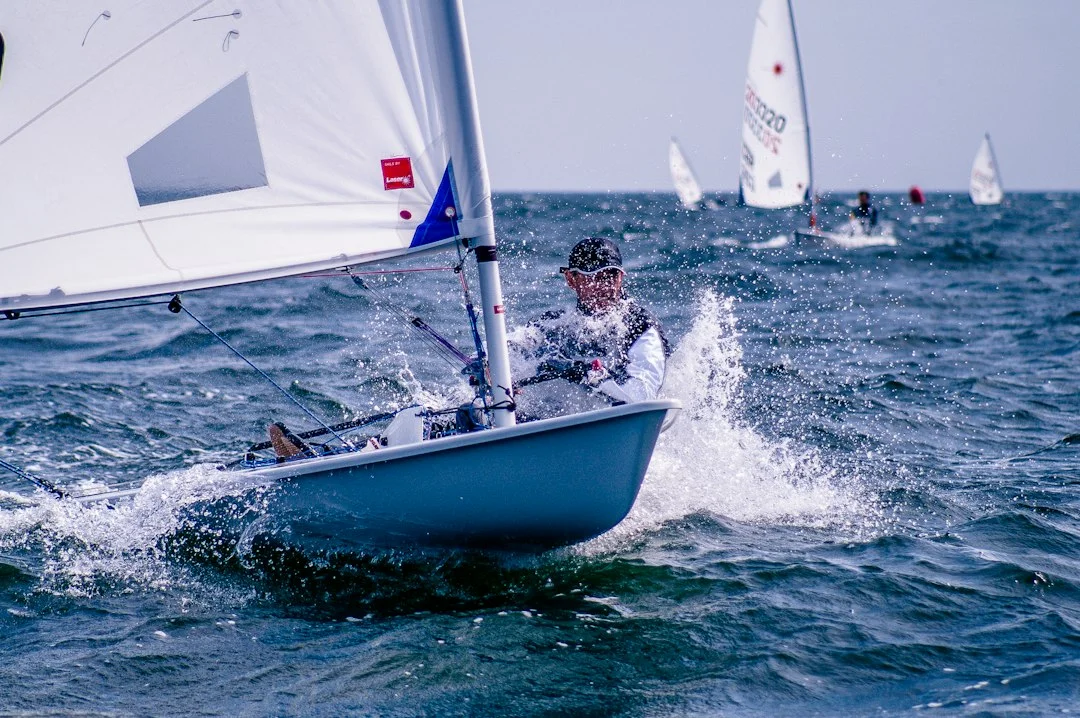
Photo by Ludomił Sawicki on Unsplash
Mainsail trim basics: twist, traveler, sheet, and draft targets
Traveler vs mainsheet: separating angle of attack from leech tension
If you learn one concept, learn this: the traveler is your “boom left-right” control, and the mainsheet is mainly your “leech tightness” control. On many production cruisers, the traveler has about 24–48 in of total track travel, and your most useful changes are small—often 2–6 in up or down. Those small moves let you keep boom position without strangling the leech.
When you pull the mainsheet hard, you usually do two things at once: pull the boom toward centerline (angle of attack) and pull down (leech tension). That’s why beginners often oversheet the main trying to point, then wonder why the boat heels like a barstool in a squall. Use the traveler to hold your lane; use the sheet to set twist.
Top batten as your twist gauge (visual targets that work)
The main’s top batten is your best free instrument. In moderate conditions, a solid baseline is the top batten roughly parallel to the boom. As wind builds, open the top by about 5–15° to spill power and reduce heel and weather helm.
If the top batten points inside parallel (hooked to windward), your leech is too tight and the sail is stalled aloft. If it points too far open, you’re dumping power you probably need—unless you’re overpowered, in which case dumping power is the point. Watch for upper leech flutter; persistent flutter is wasted cloth and usually needs a touch more sheet or vang (depending on point of sail).

Photo by Kelly Sikkema on Unsplash
Flattening controls: halyard/cunningham, outhaul, and backstay
Draft management is where cruising boats win comfort. In light air, you can live with 12–15% draft depth and draft position around 40–45% aft from the luff. In moderate air, aim more like 10–12%, and in fresh conditions, flatten toward 8–10% and move draft forward toward 35–40%.
Tools: increase halyard or cunningham tension to move draft forward, crank outhaul to flatten the lower third, and add backstay (if you have it) to reduce forestay sag and flatten the main via mast bend. Typical halyards are 8–10 mm (5/16–3/8 in); if yours are stretchy and old, draft position will wander as loads change. Replacing lines isn’t glamorous, but $40–$140 in low-stretch control line often improves sail shape more than yelling at it.
Helm balance: using trim to reduce weather helm
Weather helm is the boat telling you the main is too powerful aft, too deep, or too closed. Before you start muscling the wheel, depower: traveler down 2–6 in, open twist (ease sheet slightly), flatten with outhaul and luff tension, and then reef if you still can’t keep heel under control. If you’re sailing with an autopilot, this is doubly important because rudder angle equals battery drain and slowed average speed.
Change one control at a time and give it 20–30 seconds to show results. You’re not trying to “fix” the boat in one heroic grind. You’re trying to make the boat easy enough that you can look up, check traffic, and maybe drink coffee that’s still in the mug.
Boom vang sail trim: offwind leech control and safety
What the vang does that the mainsheet can’t (off the wind)
Off the wind, the mainsheet often stops pulling down and mostly pulls in. That’s when the boom vang becomes your primary leech tension and twist control. If the boom lifts as you ease sheet, the leech opens too much, the top spills, and the sail gets noisy and inefficient.
On many 30–40 foot cruisers, vang purchases are commonly 8:1 to 16:1, with blocks/cleats sized somewhere around 1,000–3,000 lb SWL depending on boat and rig loads. If you’re thinking about upgrades, a soft-vang/blocks refresh might cost $250–$900, while a rigid vang often lands around $900–$2,200. Before changing hardware, check the load path; ABYC H-41 (rigging) and ABYC H-40 (strong points) are good references for mounting and backing expectations.

Photo by Vidar Nordli-Mathisen on Unsplash
Beam reach to run: preventing boom lift and maintaining twist
On a beam reach, a touch of vang helps keep the boom from lifting and maintains a controlled twist profile. On a broad reach and run, the vang can prevent the top from twisting off into useless flutter. Your cues are simple: if the upper leech is fluttering and the boat feels dead, add a bit of vang; if the boat is loaded up and rounding, ease sheet and open the leech.
Don’t crank vang like you’re trying to bend the boom into modern art. You want enough downward control to keep the sail quiet and working, not enough to create shock loads during gusts. Which brings us to the part nobody enjoys talking about until after the boom tries to remove someone’s head.
Simple, safe vang procedure for cruisers (gusts + gybes)
My simple cruising procedure: set vang for the point of sail, then set a preventer if you’re deep offwind for more than a few minutes. Keep vang tension moderate so a gust doesn’t turn the rig into a lawsuit, and ease vang before an intentional gybe if it’s loaded. If you’re relying on “we’ll just be careful,” you’re budgeting for a crash gybe.
Also: avoid foredeck adventures to adjust gear when conditions build. ISO 15085 is plain common sense—stay clipped, use jacklines, and do adjustments from the cockpit when possible. Your best seamanship tool is laziness channeled into good systems.
Quick settings by wind strength: repeatable main + jib trim
The goal here is repeatability. Pick marks for your lead cars, traveler, and sheets, then refine over a few sails. Small changes—2–6 in on the traveler, one lead hole, a few inches of sheet—beat big dramatic corrections every time.
0–6 kt (light): build shape and keep flow attached
In light air you need shape, not strangulation. Keep wrinkles just barely out of the luff, accept a little more draft (main 12–15%), and avoid over-trimming the jib so you don’t choke the slot. If you’re tempted to pinch for pointing, remember you can’t point if you can’t move.
7–15 kt (moderate): baseline twist and balanced helm
This is your “normal sailing” band. Aim for the main’s top batten parallel to the boom, jib telltales streaming at all three heights, and helm that’s light with mild weather helm. If you’re fighting the wheel, you’re probably overpowered or too closed in the leech.
16–22 kt (fresh): flatten, open leech, reduce rudder load
Now you earn your coffee. Flatten the main toward 8–10% draft, move draft forward toward 35–40% with luff tension, and open the top 5–15°. Use traveler-down before you start dumping mainsheet wildly; it’s a cleaner way to reduce angle of attack without wrecking leech control.
23+ kt (strong): reef early and sail the boat flat
Reefing is the easiest speed-and-comfort upgrade you can buy, and it costs $0 if your reefing works. As a rule of thumb, many cruisers take the 1st reef around 15–18 kt TWS and the 2nd reef around 20–25 kt TWS, earlier if short-handed or in steep chop. In strong wind, the goal is a flatter, quieter sailplan and a boat that tracks without hero steering.
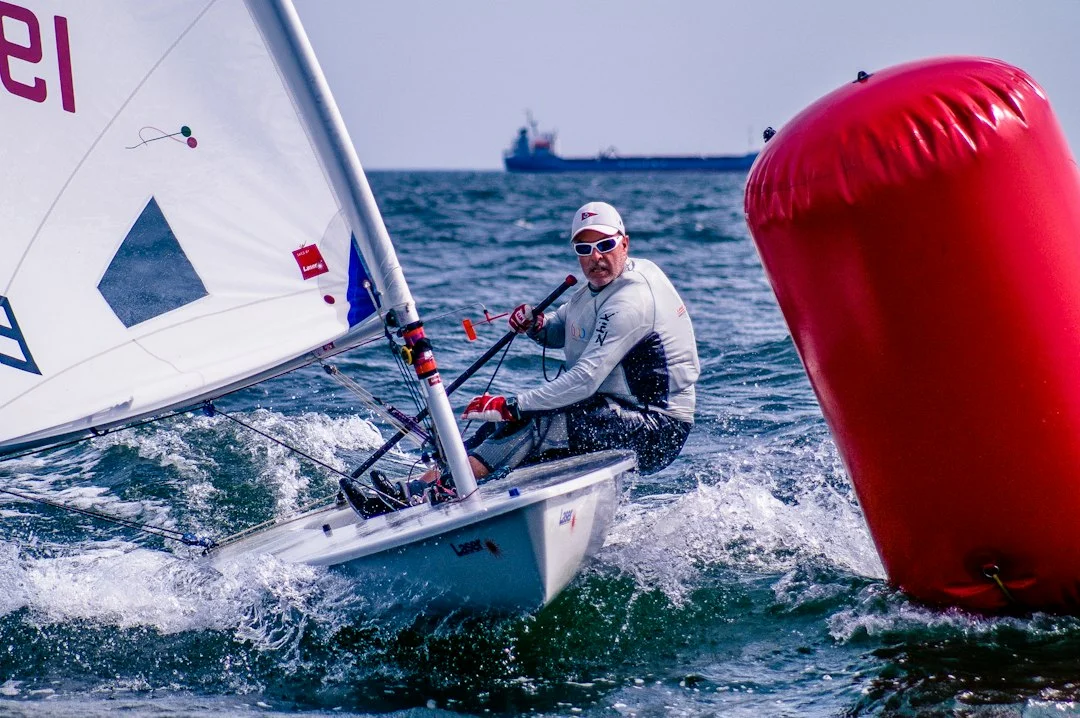
Photo by Ludomił Sawicki on Unsplash
| Wind band (TWS) | Jib lead (mark) | Jib sheet tension cue (telltales) | Traveler position (from center) | Mainsheet cue (top batten) | Vang (offwind) | Reefing action |
|---|---|---|---|---|---|---|
| 0–6 kt | Slightly forward of “base” mark | Trim to stop luffing; ease until leeward telltales just start to flick, then trim a touch | On/near center (0–2 in) to keep boom up | Slightly closed to parallel if needed to maintain flow | Usually off/light | No reef; keep shape (draft 12–15%) |
| 7–15 kt | Neutral/base mark | All three heights stream; break nearly together when you head up | Center to 2–4 in down in puffs | Parallel baseline | On as needed when sheet eased | Consider 1st reef if heel stays >25° or rudder load rises |
| 16–22 kt | Often aft of base mark to keep top working | Watch upper telltales; avoid steady stall | 4–12 in down depending on track length and gusts | Open 5–15° to depower | On to control twist offwind; ease before gybe | 1st reef 15–18 kt; 2nd reef 20–25 kt (sea state/crew dependent) |
| 23+ kt | Aft with smaller jib / partially furled (add temp telltales) | Don’t chase perfection; prioritize steady flow and low heel | Low; keep boom leeward without oversheeting | Open and flat; avoid hooked leech | Moderate + preventer; avoid hard vang | Reef early; reduce heel; if still loaded, reduce sail again |
Troubleshooting: symptoms → causes → fastest trim fix
Sail trim problems look mysterious until you treat them like engine troubleshooting: symptom, likely cause, quick check, fix in order. Start with the basics: is anything backwinded, are the telltales behaving, and is the helm balance sane? Then adjust one control and re-check.
Common reality check before you chase trim
Old sails fight you. Typical cruising Dacron is around 6.0–9.0 oz/yd², and as it ages it stretches aft, deepens, and grows a hooked leech that won’t fully “trim out.” If you can’t get draft forward even with luff tension, it may be time for a loft assessment ($150–$600 for inspection and minor tune-up) before you spend energy blaming your skills.
| Symptom | Likely cause | Quick check | Fastest fix (control order) | If still happening |
|---|---|---|---|---|
| Leeward jib telltales lifting/drooping; speed drops; feels “stuck” | Pinching or oversheeted jib | Bear off 3–5°; do leeward telltales stream? | Ease jib 1–3 in → steer for flow → re-trim to “just flick” | Check lead position; add telltales if missing |
| Upper jib telltales drooping while lower streams | Lead too far aft; top too closed | Watch upper pair for 5–10 sec average | Move lead forward 1 hole/1–2 in → re-check break-even | Sail may be too full aloft; consider smaller jib/reef main |
| Lower jib telltales drooping first | Lead too far forward; foot over-tight | Look at foot shape and lower leech | Move lead aft 1 hole/1–2 in → re-check break-even | Partially furled sail shape may be poor; add temp telltales |
| Too much heel (>~25°) + heavy weather helm | Main too deep/closed; too much power aft | Check top batten: hooked? helm angle >10°? | Traveler down 2–6 in → open twist (ease sheet) → flatten (outhaul + luff tension) | Reef; if persistent, check sail age/rig tune |
| Main backwinding at luff | Slot too tight; jib too tight or main too closed | Look for bubbles at main luff | Ease jib slightly → adjust jib lead → traveler down/open main | Change course a few degrees; don’t force pointing in chop |
| Leech flutter on main offwind | Not enough leech tension when sheet eased | Watch upper leech + top batten | Add vang gradually → then adjust sheet for angle | If excessive, check leech line/sail wear |
| Poor pointing despite good trim | Waves, dirty bottom, sagging forestay, tired sails | Compare speed vs similar boats; check telltales | Foot off a few degrees for flow → build speed → then head up | Inspect bottom/rig tune; consider loft recut/new sail |
Route planning tie-in: using trim to hit ETA and comfort targets
From trim to speed: realistic gains and when they matter
On a passage, your average speed matters more than your best moment. A boat sailing flatter with less rudder drag often gains 0.5–1.0 kt on average compared to an overpowered boat rounding up in gusts. That can happen even when the overpowered boat “feels faster” for a few minutes at a time.
Apparent wind changes with both boat speed and course, which is why easing a touch in chop can improve average VMG. If you keep flow attached and helm balance neutral, the keel does its job and the autopilot doesn’t spend the day steering S-curves. The fastest boat on a cruise is usually the one that wastes the least motion.
Sea distance and ETA: simple calculations cruisers actually use
Keep ETA math simple: hours = distance (NM) ÷ average SOG (kt). For a worked example, a 42 NM coastal leg at 5.5 kt average SOG takes about 7.6 hours; at 6.2 kt it takes about 6.8 hours, nearly 50 minutes saved. That’s the difference between arriving in daylight and arriving with your headlamp in your teeth.
Use your plotter’s “distance to waypoint,” paper chart dividers, or calculate the distance between ports when you’re sketching options before you leave. I also like checking nautical miles for alternate waypoints for quick “if we fall off 10° for comfort, what does that do to miles?” checks, which helps settle arguments on board. If you’re running an engine-sail leg, those distance numbers also feed basic fuel planning.
Short-handed workflow: when to change trim vs change plan
Short-handed sailing is about reducing tasks, not winning style points. If conditions are building and you’d need a foredeck trip to move leads, consider changing course, reefing, or switching to a smaller headsail instead. ISO 15085 logic applies here: fewer cockpit exits, better timing, and tethers when you go.
For planning, set “comfort gates.” If your heel or helm threshold is exceeded for 10 minutes, do something decisive: reef, bear off, or pick a different waypoint. Then sanity-check your new ETA (and estimate your fuel needs based on the voyage distance if motoring is likely) so you’re not guessing your arrival into a closing inlet.
Frequently Asked Questions
When the upper jib telltales stall first but lower/mid stream, how many holes or inches should I move the jib lead car aft to re-balance twist, and what’s the confirmation check?
Move the lead in small steps: typically 1 hole or about 1–2 inches on many tracks, then re-check for 5–10 seconds to average gusts and waves. If the upper telltales were stalling first, you usually want a change that makes the top and bottom “break” more evenly when you head up slowly. Confirmation check: steer up until telltales start to lift and aim for top/mid/bottom to break nearly together, with no steady stall up high.
How do I quantify mainsail twist using the top batten angle (parallel vs 5–15° open), and which control should I change first: traveler, mainsheet, or vang?
Use the boom as your baseline: in moderate air, aim for the top batten roughly parallel to the boom; when depowering, let it open about 5–15°. Upwind, change traveler first to adjust angle of attack without wrecking leech tension, then fine-tune mainsheet for leech/twist; offwind, use vang first to control leech tension when the sheet is eased.
In 16–22 kt true wind, what control sequence most reliably shifts draft position forward (from ~45% to ~35–40%) without over-tightening the leech?
Start with luff tension: add halyard or cunningham to pull draft forward toward 35–40%. Then flatten with outhaul to target roughly 8–10% draft depth, and add backstay if available to firm forestay and encourage mast bend. After that, use traveler and sheet to keep twist appropriate; don’t try to “sheet it flat,” because that often just hooks the leech.
How do traveler-down changes (2–6 in) compare to easing mainsheet in terms of angle of attack, leech tension, and helm balance on a 30–40 ft cruiser?
A 2–6 inch traveler-down move reduces main angle of attack while keeping leech tension more stable, so twist doesn’t blow open as quickly. Easing mainsheet reduces leech tension and usually increases twist, which can depower but may also increase leech flutter and reduce pointing. For helm balance, traveler-down is often the cleaner first step in gusts because it eases weather helm without making the sailplan sloppy.
What hardware specs should I verify before upgrading a vang (purchase 8:1–16:1, component SWL range ~1,000–3,000 lb), and which ABYC guidance applies to mounting strong points?
Verify the vang purchase ratio (8:1–16:1), and confirm blocks, cleats, and shackles have an appropriate SWL, often in the ~1,000–3,000 lb range for 30–40 foot cruisers (your boat may require more). Inspect attachment points for proper backing and load paths, and check that the boom and mast fittings are designed for those loads. ABYC H-41 (sailboat rigging) and ABYC H-40 (strong points/load paths) are the right references when you’re evaluating mounting and structure.
If you want one last repeatable workflow, here it is: telltales → top batten → helm balance → traveler/sheet/vang tweak → re-check after 20–30 seconds. Then mark what worked for the four wind bands, because the sharpest trim tool on a cruiser is a bit of tape and a reliable habit.
About the Author
Related Articles

Sailboat Bimini Guide: Dodger & Enclosure Choices
Learn how to choose a sailboat bimini, dodger & cockpit enclosure—materials, fit, costs, and DIY vs pro. Get the right setup today.
By Breezada Team
Code Zero vs Genoa: Jib & Spinnaker Guide
Compare Code Zero vs genoa, jib, and spinnaker by wind range and angle. Choose the right headsail for your boat—read the guide now.
By Breezada Team
Starlink Mini on a Boat: Plans, Power & Offshore Use
Learn Starlink Mini on a boat—plans, power draw, and offshore performance. Compare Roam vs Mobile Priority and get setup tips. Read now.
By Breezada Team
Boat Courtesy Flag & Q Flag Etiquette for Yachts
Learn boat courtesy flag and Q flag etiquette for yachts—what to fly, where to hoist it, and common mistakes. Get the checklist before landfall.
By Breezada Team