Dock in a Slip with Finger Piers: Wind & Current
Docking in a finger-pier slip isn’t about “having a technique.” It’s about having a plan that matches the geometry, the set, and what your boat actually does at low speed. Do that, and your docking gets boring—in the best way.
A good slip docking is usually decided before you enter the fairway: you’ve already picked bow-in vs stern-in, you’ve already rigged for the outer corner that wants to eat your topsides, and the crew already knows which line lands first. If you’re improvising at the finger pier, you’re late.
Photo by boris misevic on Unsplash
Understand Slip, Finger Pier & Fairway Geometry
Slip width vs beam: clearance that actually matters
Slip geometry drives your plan more than any textbook docking “method.” Typical monohull slips are listed in 10/12/14/16 ft widths and 25/30/35/40/45 ft lengths, and those numbers are optimistic because the real “usable” width shrinks when pilings lean, rub rails stick out, and your neighbor hangs fenders like a porcupine. A comfortable target is ~2+ ft total side clearance (roughly a foot each side), because fenders compress and boats don’t stop instantly at 0.5–1.0 knots.
When total clearance is only ~1–2 ft, you’re in a tight slip even on a calm day. Now your timing changes: fenders must be set before you turn in, your approach speed has to be genuinely dead slow, and you should assume one gust will arrive right when your bow is lined up with the finger-pier corner. Tight slips reward spring lines and punish “I’ll just bump it gently” optimism.
Finger pier lengths, corners, and snag hazards
Finger piers commonly run ~25–40% of slip length, with ~3–5 ft of walking surface, and their freeboard changes with tide and dock design. The outer corner is the classic impact point: it catches forward quarters bow-in, and it catches aft quarters stern-in. If you’ve got shrouds, lifelines, a genoa track, or a stern rail that can hook a cleat, that corner will try to collect it.
High-risk contact points in finger-pier slips are predictable: outer corner, aft quarter, shrouds/lifelines, and bow pulpit overhang. Walk the slip (if you can) and look for proud bolts, cleats aimed at your stanchions, and splintered corners that indicate prior “learning experiences.” If a piling sits where your midship will pass within a foot, rig an extra fender there—before you enter.
Fairway width and turning room: when backing in is realistic
Fairway width is the silent deal-breaker. A common guideline is ~1.5×–2.0× slip length, while older marinas can be ~1.25×, and that last number makes crosswind docking noticeably spicier. In a narrow fairway, you don’t have time to stop sideways, realign, and try again without blocking traffic or getting set down onto someone’s bow pulpit.
At low speed, your sailboat pivots around a point that shifts forward as you make way. That pivot point concept matters because it tells you what will hit first when you turn: the bow swings wider than you think when you’re still carrying momentum. Before entry, do a simple observation routine: check flags, look for wind lines on the water, note any current set along pilings, and watch traffic flow for 60 seconds. If you want help quantifying the approach distance and timing, check the nautical miles for your planned route is handy for planning your arrival window around slack and daylight.
Photo by Robert Zunikoff on Unsplash
Pre-Docking Setup: Lines, Fenders, and Engine Readiness
Fender placement for finger piers (including corner protection)
Your fender plan should match where you’ll touch if something goes wrong—not where you hope you’ll touch. For 30–40 ft monohulls, the usual rule is ~1 inch of fender diameter per 4–5 ft LOA, which lands you in the 6.5–8.5 inch cylindrical fender range. In a finger-pier slip, I want minimum 3 on the dock side (bow/midship/stern) plus 1–2 more for the outer corner or a piling that sits proud.
Set fender height for the dock you actually have today, not the one you had last weekend. Floating docks can meet you around mid-freeboard, while fixed docks at low tide can target your toerail or even topsides above the rub rail. Adjust before you enter the fairway, because trying to move a fender when you’re two feet from a corner is how people lose boathooks and dignity.
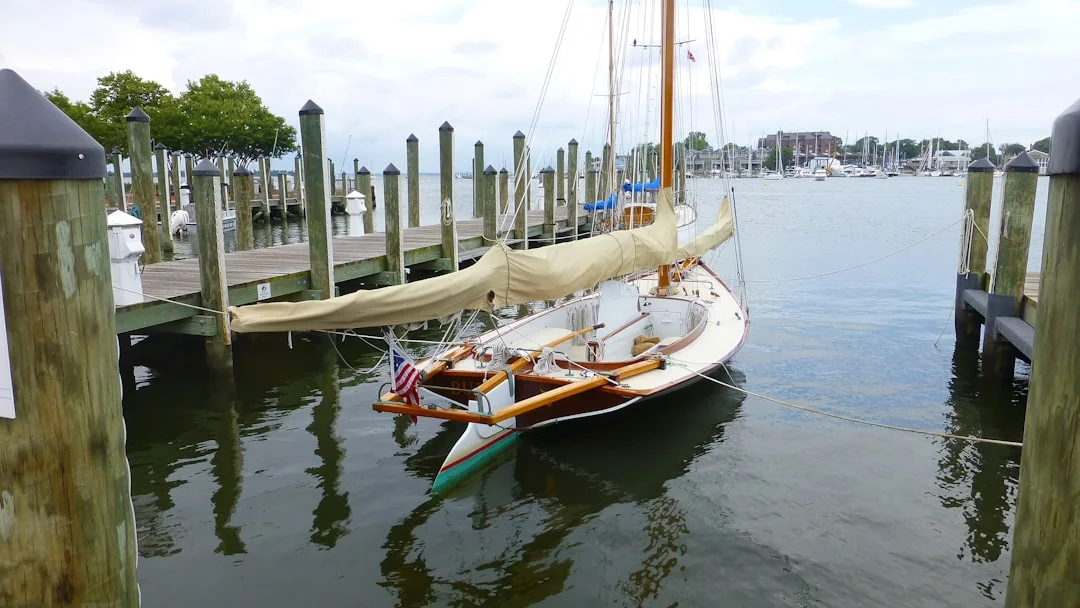
Photo by alvin matthews on Unsplash
Dock line sizing and lengths by LOA
Dock lines aren’t fashion accessories; they’re load paths. A solid rule of thumb is line diameter ≈ 1/8 inch per 9 ft LOA, so 30–36 ft boats usually run 1/2 in double-braid nylon, and 40–45 ft boats step up to 5/8 in. For lengths, bow and stern lines around ~0.66× LOA are workable, while spring lines around ~1.0× LOA give you the reach to lead forward or aft without running out of tail.
Here’s what that looks like in practical numbers:
| Boat LOA | Typical line diameter | Bow/Stern length (~0.66× LOA) | Spring length (~1.0× LOA) |
|---|---|---|---|
| 30 ft | 1/2 in | ~20 ft | ~30 ft |
| 35 ft | 1/2 in | ~23 ft | ~35 ft |
| 40 ft | 5/8 in | ~26 ft | ~40 ft |
Budget-wise, expect $25–$60 per 1/2 in line and $45–$110 per 5/8 in line, depending on length and splice quality. Add $15–$40 for chafe guards, because spring lines in gusts will saw through unprotected fibers overnight.
Pre-rigging for bow-in vs stern-in
My “minimum viable” line set for finger piers is: bow line, stern line, forward spring, aft spring, plus one spare that can become a second spring or an emergency breast line. Pre-rig them led outside lifelines and shrouds, with bitter ends coiled so they’ll run without turning into a macramé project. If you’re going to use a midship spring capture, lead it from the midship cleat to the cockpit where the handler can drop it cleanly.
Engine readiness matters in tight quarters. COLREGS Rule 6 (safe speed) doesn’t disappear because you’re inside the marina; it’s why most docks post 5 mph or no wake (~3–5 mph). If you have a gasoline auxiliary, ABYC H-2 guidance is simple: run the blower for at least 4 minutes before start, and keep ventilation in mind while you’re idling in close quarters. I also want bilge status checked—ISO 15083 is about pumping systems, but the real point is practical: don’t discover a rising bilge when you’re committed between finger piers.
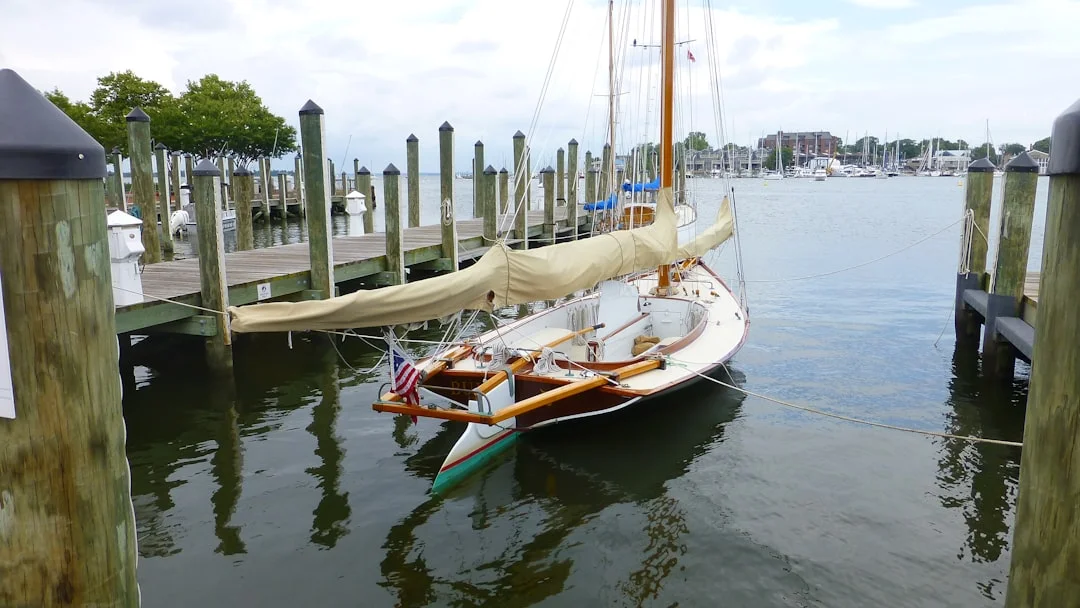
Photo by alvin matthews on Unsplash
Crew Roles, Commands, and No-Injury Docking Rules
2-person vs 3–4-person crew choreography
With two people, the helm must also manage timing and engine, so the crew member needs a job that actually stops the boat: midship spring handler is usually the best return on effort. With three to four people, you can assign bow, stern, and a safety/boathook role, but don’t confuse “more hands” with “better docking.” Too many helpers creates a chorus of uncoordinated advice, which is a reliable way to hit the wrong corner.
For docking to port, pre-set port fenders and port-side working lines; for docking to starboard, mirror it. It sounds obvious until you watch a crew run a starboard docking with port fenders because “that’s how we always do it.” Finger piers don’t care about your habits, only your angles and timing.
Line-handling priorities: which line lands first and why
Your first line should create control, not just connection. In wind or current, a midship spring often lands first because it can stop fore-and-aft motion and create a controlled pivot with gentle engine pressure. ABYC H-40’s focus on strong points is relevant here: spring loads can spike in gusts, so use properly backed cleats and avoid loading a flimsy stanchion base or an “accessory” cleat.
If you’re working with dockhands, ask for a wrap on a cleat—not for them to pull the boat in. A dockhand hauling your lifelines like a gym rope rarely improves outcomes. Neighbors mean well, but they’ll grab whatever they can reach, and it’s often the wrong line at the wrong time.
Communication script and hand signals
Docking is not the moment for creative language. Use a short script: “Stand by bow line,” “Stand by midship spring,” “Neutral,” “Idle ahead,” “Line on,” and “Abort.” Hand signals work when the wind is loud: a flat palm for stop/neutral, a finger point for which cleat, and a circular motion for “take in slack.”
Safety rules are non-negotiable: no hands or feet between boat and dock, no jumping, and no fingers inside a cleat. USCG safety equipment isn’t theoretical here—have a wearable PFD for each person, a throwable on 16 ft+ boats, a sound device, and make sure nav lights work if you’re docking at dusk. If you need to step off, step off at the widest, lowest point (often near the shrouds), and only when the boat is already under control.
Practical tip: If a crew member’s job requires them to “save the boat with their body,” the plan is wrong. Make the boat obey lines and engine, not ankles and fingertips.
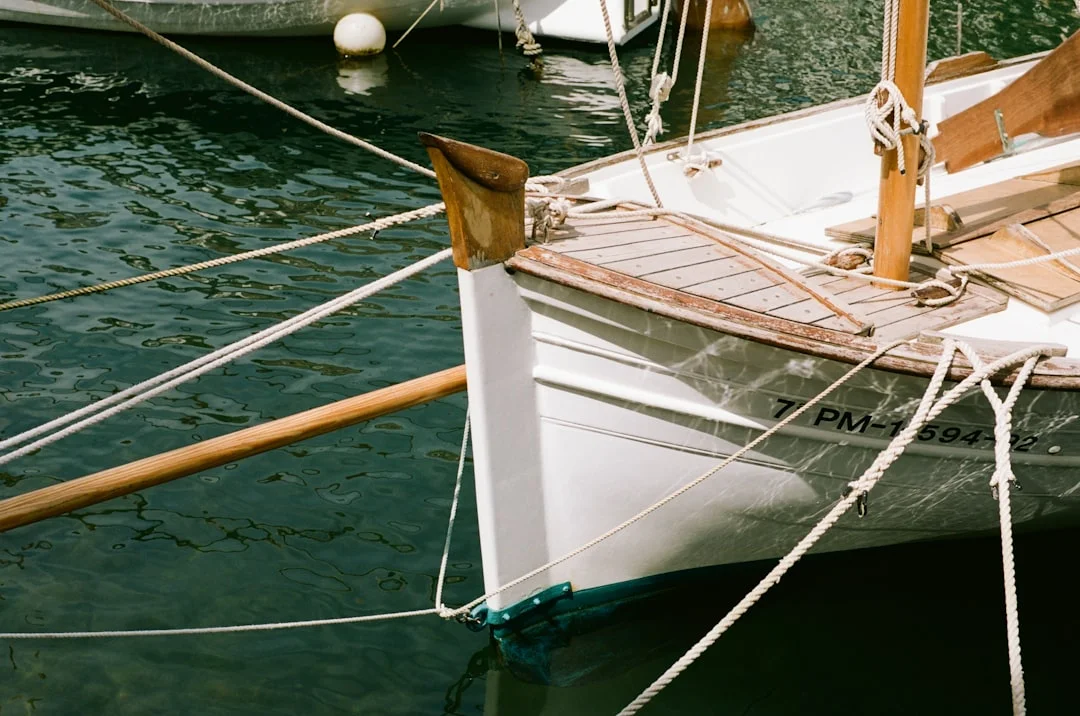
Photo by Jean Carlo Emer on Unsplash
Step-by-Step: Bow-In Docking in a Finger-Pier Slip
Set up the approach: alignment, speed, and neutral-coast control
Bow-in is straightforward when you keep it slow and organized. Stabilize in the fairway first, then turn toward the slip with enough time that you’re not carving a last-second S-turn. At the moment of line capture or contact, target 0.5–1.0 knots (0.26–0.51 m/s)—because kinetic energy climbs fast with speed, and docks are undefeated in that contest.
Use neutral deliberately. A sailboat carries momentum, and continuous throttle creates prop wash that over-rotates the bow and encourages frantic corrections. My default pattern is a short burst in gear, then neutral coast, then another short burst; it feels slow from the helm, which is exactly the point.
Final 1–2 boat lengths: capture a cleat without drifting past
At 1–2 boat lengths out, you should already be aligned enough that you’re not relying on luck. In light crosswind, aim slightly upwind so the boat “settles” onto the centerline as you lose way. If you’re not aligned by that gate, back out and reset; trying to fix alignment inside the slip usually ends at the outer corner with a loud apology.
The high-risk bow-in contacts are the forward quarter on the finger-pier corner and shrouds catching on dock hardware as you slide alongside. Keep crew focused on line capture, not fending off. A boat hook is for retrieving a line or pushing off gently, not for jousting with pilings.
Secure sequence: springs first, then bow/stern
If conditions are calm, you can land a bow line first and then a stern line. In wind or current, I prefer a spring-first capture, because it gives you a brake and a pivot. Aim for a spring line angle around ~20–45°; too flat and it won’t restrain movement, too steep and it won’t control fore-and-aft well.
A consistent tie-up order that works in most finger-pier slips is: spring → opposite spring (if needed) → bow → stern → final breast adjustments. Once the spring is on, use idle ahead gently against it to bring the boat alongside, then shift neutral while the crew makes fast. That’s controlled docking, not ramming-and-recovering.
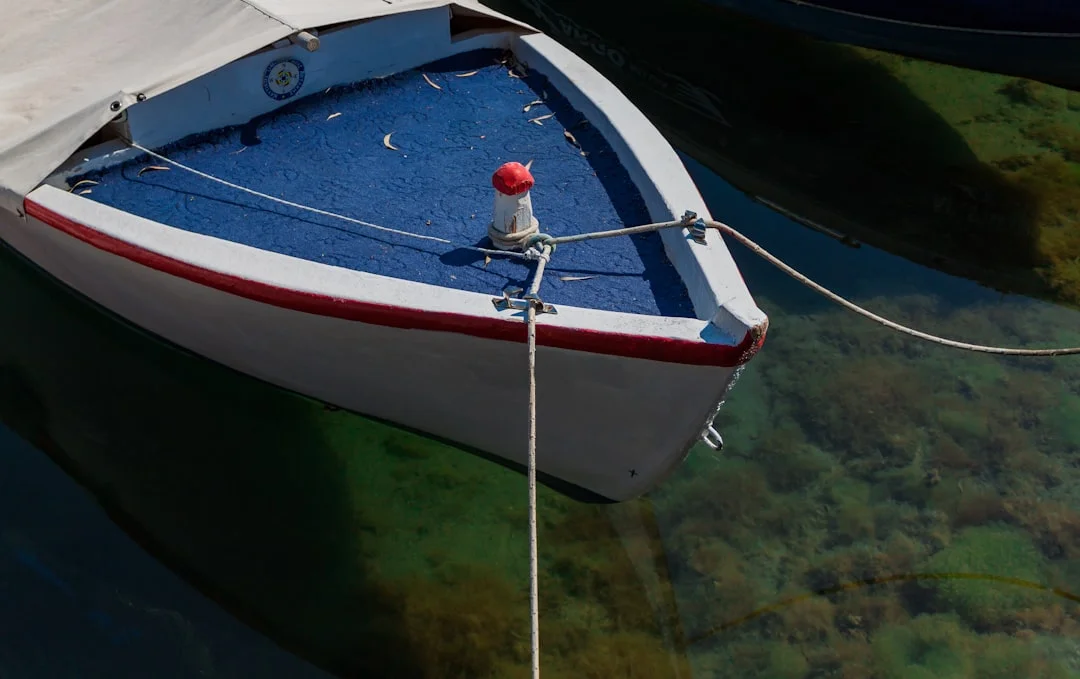
Photo by George Liapis on Unsplash
Step-by-Step: Stern-In (Backing) with Prop Walk Control
When stern-in is the better plan (and when it isn’t)
Stern-in can be easier because you can see the slip edges better, and once the stern is in, you can control the bow with a forward spring and gentle ahead power. It also helps when your bow gets blown off aggressively—many boats with higher freeboard (ISO 12217 stability categories are partly why designs differ) will “skate” sideways faster up forward than aft. If your marina has a narrow fairway around ~1.25× slip length, stern-in may still be the right call, but only if you can line up without blocking traffic.
Stern-in isn’t the move when you have poor reverse control, a lot of prop walk you haven’t practiced, or significant cross-current that will shove your stern sideways before it gains sternway. If your crew can’t reliably land an aft line without lunging, don’t make stern-in your first experiment in 20 knots.
Back-down technique: bursts, neutral, and steering authority
Reverse steering needs water flow over the rudder, but that doesn’t mean high RPM. Start lined up in the fairway, then use a short reverse burst to establish sternway, then go neutral and steer as the boat continues moving. Repeat: burst, neutral, steer; continuous reverse often just digs a hole and magnifies prop walk.
Plan your speed the same way as bow-in: by the time you’re at line-capture distance, you want ~0.5–1.0 knots of actual motion. When you need to slow, a brief reverse burst to stop the boat is fine, but don’t use “panic power” that slams the stern sideways. The stern is close to the dock, and fiberglass doesn’t get tougher because you’re stressed.
Using prop walk deliberately to center the stern
Most right-hand props (clockwise in forward) will walk the stern to port in reverse, often strongest at low speed with a high-power burst used to stop. That means if you back into a slip, you can start with the stern slightly offset so prop walk helps you center instead of sabotaging you. Boats with offset props, aperture limitations, or full keels can exaggerate or soften this behavior, so test it in open water before you bet your gelcoat on it.
Line priority stern-in is usually: land the stern line or aft spring to arrest drift, then a forward spring to control fore-and-aft, then bow line last once the boat is stable. If crosswind is pushing you sideways at ~15–20 knots, you’ll often do better with a spring-line-first plan or by waiting for a lull. A docking lesson runs $150–$400 for 1–2 hours, which is cheaper than a rub-rail repair and a fight with your insurance deductible.
Docking in Wind: Crosswind, Headwind, and Gust Management
Crosswind strategy: upwind aim point and timing the “settle”
Wind in marinas is rarely steady. Read it on the small scale: flags, masthead fly, ripples, and the wind shadow behind buildings or trees. In crosswind, your job is to control angle early and speed late; if you chase speed first, you’ll enter the slip sideways and “fix it” by adding power, which is how corners meet gelcoat.
A practical threshold: when crosswind is ~15–20 knots, most cruising sailboats need a tactic change. That might be spring-line-first, requesting a dockhand for a controlled wrap, or waiting for a lull and timing your entry. If you’re planning an arrival into a known windy harbor, plan your route using a sea distance calculator helps you back-time your departure so you’re not docking at peak afternoon thermals.
Spring-line-first in 15–20 knots: stop, pivot, and slide in
The spring-line-first method is the closest thing to a cheat code in wind. You put a midship spring on (or a forward spring if midship isn’t workable), then use idle-ahead against the spring to bring the boat alongside while the spring prevents forward motion. The working spring angle should be ~20–45°; flatter angles reduce braking and pivot effect, while steeper angles can load cleats without giving you good control.
Once the spring is loaded lightly, you can pause in neutral, let the boat settle, and then land the remaining lines without the boat wandering off. This is also where ABYC H-40 matters again: spring loads in gusts can be sharp, so use a backed cleat and avoid shock loading. If you’re staying overnight in wind, add a snubber ($20–$70) and chafe gear to the working spring.
Leeward vs windward side choices in finger-pier slips
If you have a choice of which side to dock, windward docking (wind pushing you off) often allows a controlled approach with less risk of getting pinned on the wrong corner. Leeward docking (wind setting you onto the dock) can be safe if you’re slow and fendered, but it offers fewer second chances. In a tight slip with only ~1–2 ft total clearance, leeward docking is where “just a little fast” becomes expensive.
Gust response should be boring: hold course with minimal rudder, shift neutral, and don’t add speed to fight sideways set near hard objects. If a gust shoves you toward the wrong corner and you can’t land a line within reach, that’s an immediate abort, not a bravery contest. The dock will still be there after you reset—your pride will recover too, eventually.
Docking in Current: Ferry Angles, Timing, and Holding Position
Assess current set and drift before committing
Current is different from wind because it doesn’t care whether you’re in neutral. Before committing, watch pilings and floating debris for set, then do a brief neutral coast to verify your drift rate. A cross-current of 1–2 knots is enough to ruin a casual approach, and in passes and channels you can see 3–5+ knots, which turns fairways into conveyor belts.
Time your arrival if you can. Checking tide/current stations and aiming for slack is seamanship, not overthinking; it’s also how you avoid looking like you’re docking on a treadmill. When you’re planning the day’s run, estimate your fuel needs based on the voyage distance can help you estimate arrival time and coordinate it with the predicted current window.
Cross-current into a slip: higher approach angle, earlier capture
The tool here is a ferry angle: aim up-current so your track stays centered where you want to go. The stronger the current, the earlier you must commit to that angle, because you need time for your sideways correction to develop without drifting into a neighbor’s bow. Even 1 knot of cross-current in a tight fairway can force a more aggressive approach angle and a faster decision cycle.
Current changes line priorities because drift continues even when your speed through the water is near zero. That means you need a controlling line earlier—again, spring-line-first is often the safe play. If you wait until you’re fully inside the slip to “start tying up,” the current will keep translating you sideways until you hit something.
Powering against a spring to hold station
Once a spring is on, you can use the engine to hold position gently. Put the engine at idle ahead against a forward spring to stop forward motion and pin the boat alongside while the crew makes fast. Keep loads reasonable and use properly installed cleats; ABYC H-40’s emphasis on strong points is exactly about these real docking loads, not theoretical ones.
Your abort plan in current should be decisive. Back out with enough authority to regain steering, re-enter from up-current, and avoid getting swept broadside where you lose rudder effectiveness. COLREGS Rule 2 (responsibility) and Rule 6 (safe speed) apply here in spirit and letter: slow enough to avoid damage, but not so timid that you lose control.
Docking Plan, Abort Protocol, and Skill-Building Drills
Choosing bow-in vs stern-in vs spring-line-first should be a decision tree, not a mood. The key variables are wind direction, current direction, slip clearance, fairway width, prop walk, and crew count. If your beam-to-slip leaves only ~1–2 ft total clearance, assume extra fenders, a spare spring, and a spring-first plan whenever wind or current is present.
Here’s the comparison table I keep in my head when things get busy:
| Condition | Best tactic | First line to land | Abort trigger |
|---|---|---|---|
| Wind 0–10 kn | Bow-in or stern-in (preference) | Bow or stern line | Not aligned by ~1–2 boat lengths |
| Wind 10–15 kn | Bow-in with angle discipline | Midship/forward spring | Can’t reach a cleat without leaning/jumping |
| Wind 15–20 kn | Spring-line-first | Midship spring | Set toward wrong finger corner |
| Current 0–1 kn | Normal plan | Bow or stern line | Speed creeping above ~1.0 kn near dock |
| Current 1–2 kn | Ferry angle + early spring | Midship/forward spring | Drift continues with no line captured |
| Current 2+ kn | Time for slack or request help | Spring (pre-rigged) | Getting swept broadside in fairway |
| Fairway 2.0× slip length | Either | Any controlling line | Traffic conflict developing |
| Fairway 1.5× slip length | Favor minimal stopping sideways | Spring-first if crosswind/current | Over-rotation with no room to reset |
| Fairway 1.25× slip length | Commit only when stable | Spring-first, slow | Any unstable alignment at entry gate |
A clean abort looks like this: call “Abort,” all crew freeze line tossing, helm goes to neutral, then reverse with enough throttle to regain steering, and exit to a safe staging spot outside traffic. Re-brief the crew in one minute, reset lines and fenders, and try again with a different plan. The only shameful abort is the one you didn’t call early enough.
Practice drills that transfer directly: (1) reverse straight for 3–5 boat lengths without weaving, (2) neutral-coast stopping accuracy from 2 knots down to 0, and (3) spring-line pivot turns using idle ahead against a spring and then neutral. Gear that improves outcomes is cheap compared to repairs: extra dock lines ($25–$110 each), fenders ($20–$80), an extendable boat hook ($25–$90), and chafe gear ($15–$40). If you want the fastest improvement per dollar, buy one more spring line and practice using it.
Docking Checklist (Numbers-First) + Crew Script
Keep this where you can see it—laminated if your boat enjoys spray.
- Speed at line capture/contact: 0.5–1.0 kn
- Comfortable slip clearance: ~2+ ft total; tight at ~1–2 ft total
- Wind tactic change: ~15–20 kn crosswind → spring-line-first / request help / wait
- Current caution: 1–2 kn cross-current demands ferry angle + earlier line capture; 2+ kn consider timing for slack
- Fairway reality check: ~1.5×–2.0× slip length is workable; ~1.25× means errors compound fast
- Abort gate: not aligned by ~1–2 boat lengths outside the slip → back out and reset
Crew script (short and repeatable):
- “Stand by midship spring.”
- “Stand by bow/stern line.”
- “Neutral.”
- “Spring on.”
- “Idle ahead… neutral.”
- “Make fast bow… make fast stern.”
- “Adjust for chafe and tide.”
The safest docking is the one you can abort early and repeat consistently. Practice the drills on a calm weekday, then bring those same steps to the windy Saturday arrival when everyone is watching—because of course they are.
Frequently Asked Questions
For a 35 ft monohull, what dock line diameter and minimum spring line length should I use to safely power against a midship spring without overloading cleats?
Use 1/2 in double-braid nylon as a practical baseline for a 35 ft monohull (rule of thumb: 1/8 in per 9 ft LOA), and make your spring line at least ~1.0× LOA, so ~35 ft. Power only at idle and keep the spring angle around 20–45° to reduce shock loading; ABYC H-40 logic applies—use a properly backed midship cleat and add chafe protection if you’ll hold load for more than a few minutes.
How do I calculate the correct ferry angle when I have ~1.5 knots of cross-current in the fairway and want to track straight into a finger-pier slip?
Use the simple vector idea: you aim up-current so your sideways component cancels the current. Practically, if your boat can make about 2.5–3.5 kn of controlled speed through the water in the fairway, a 1.5 kn cross-current may require a noticeable crab angle—often on the order of a few boat-widths of “nose-up-current” over a slip-length approach. Confirm with a short neutral coast to observe set, then adjust your heading until your track (not your bow) stays centered.
With a right-hand propeller, what initial stern-in alignment offsets prop walk to port, and when should I use throttle bursts vs continuous reverse?
Assume a right-hand prop will walk the stern to port in reverse, especially during strong “stop” bursts at low speed. For stern-in, start with the stern slightly to starboard of where you want it, so the walk brings you toward center as sternway builds. Use short bursts + neutral to create flow over the rudder without amplifying walk continuously; steady high-RPM reverse often increases sideways translation and reduces your ability to correct cleanly.
What spring-line lead (forward vs aft) best prevents surging in a slip with reversing tidal flow, and what line angle range produces the most control?
In reversing flow, rig both a forward and an aft spring if you can; that’s what truly prevents surging as current flips. If you must choose one in the moment, land the spring that most directly opposes the current-driven motion you’re seeing right now, then add the opposite spring once stable. For control, target a 20–45° spring angle; too flat won’t restrain movement well, and too steep loads hardware without giving you a useful braking/pivot effect.
How should I place fenders to protect against the finger pier outer corner and pilings when total side clearance is only ~1–2 ft?
Rig at least 3 fenders on the dock side (bow/midship/stern) sized appropriately for your LOA (often 6.5–8.5 in diameter for 30–40 ft boats), then add 1–2 dedicated “corner/piling” fenders set slightly forward of where the finger pier corner will meet your hull during the turn. In a ~1–2 ft total clearance slip, consider a fender board if pilings are rough, and set fender heights before entry to match today’s dock height and tide—because you won’t have room to fix it later.
About the Author
Related Articles
San Francisco Bay Sailing: Winds, Tides & Hazards Guide
Plan safer San Francisco Bay sailing with wind patterns, tides, currents, fog and key hazards. Use this guide to pick a route and go sail today.
By Breezada Team
Sailboat Engine Won't Start: Diagnostic Flowchart
Troubleshoot a sailboat engine that won't start with a step-by-step flowchart for batteries, starter, fuel, air, glow plugs & alarms. Fix it now.
By Breezada Team
Sailboat Bottom Paint Guide: Types, Costs & Prep
Learn sailboat bottom paint types, costs, and prep steps—plus how often to repaint. Get the right antifouling plan for your boat today.
By Breezada Team
Diesel Heater Troubleshooting Boat: No-Start & Soot Fixes
Fix diesel heater no-start and sooting on your boat. Step-by-step checks for power, fuel, air/exhaust and maintenance—read the guide now.
By Breezada Team