Someone just went over the side. You have maybe four minutes of clear thinking before panic overrides training — less if the water is cold. Man overboard is the scenario every sailor hopes never happens and the one every crew must be ready for. The difference between a successful recovery and a tragedy comes down to practiced procedures, assigned roles, and equipment you can actually deploy under stress.
This guide covers everything: the immediate response, sail-powered and engine-powered recovery maneuvers, crew coordination, the gear that matters, and the cold-water realities that textbooks tend to gloss over.
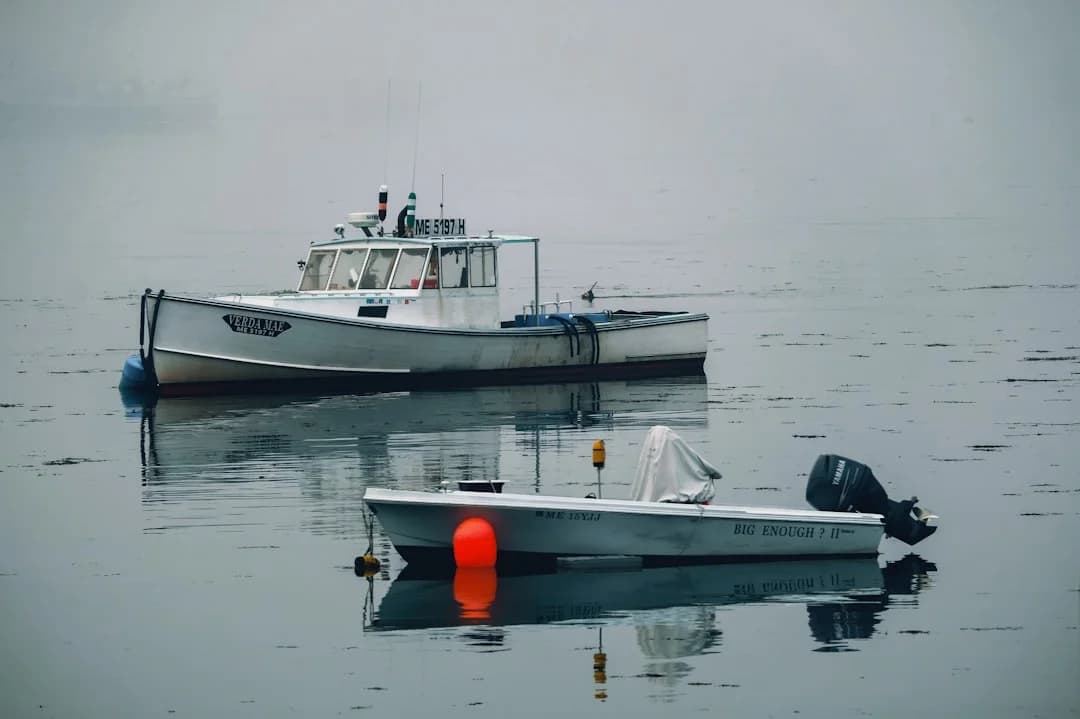
Photo by Franz Schmitt on Unsplash
The First 10 Seconds: Immediate Response
The initial seconds after a man overboard incident determine everything that follows. There is a specific sequence, and it needs to be reflexive — not something you look up in a manual while your crewmate drifts away.
Step 1: Shout "MAN OVERBOARD" and point. The person who sees the fall shouts immediately. One crew member is assigned as the dedicated spotter — their only job from this moment forward is to point at the person in the water and never look away. In moderate seas, a human head disappears behind 1-meter waves at just 100 meters of distance. Losing visual contact is devastatingly easy.
Step 2: Throw flotation. Immediately throw a life ring, horseshoe buoy, or any buoyant object toward the person. Don't aim for perfection — aim for proximity. A cushion, a fender, a sealed jerry can — anything that floats and gives the person something to grab. If your life ring has a drogue and light attached, even better.
Step 3: Press the MOB button. Most modern chartplotters and GPS units have a dedicated MOB button that marks the position instantly. Hit it. On many sailing apps — and modern navigation tools like Navionics or Savvy Navvy — the MOB function is accessible in one or two taps. That GPS waypoint becomes your lifeline if you lose visual contact.
Step 4: Start the recovery maneuver. The helmsperson begins the chosen approach immediately. Which maneuver depends on your point of sail, crew experience, and whether the engine is available.
Recovery Maneuvers Under Sail
When the engine is not an option — whether it won't start, the prop is fouled, or you're offshore with no fuel — you need to recover under sail alone. There are three classical approaches.
The Quick-Stop Method
This is the most widely taught MOB recovery maneuver and the one recommended by the Cruising Club of America, US Sailing, and the RYA.
- Immediately tack the boat, leaving the jib backed (don't release the jib sheet)
- The backed jib slows the boat rapidly — this is the "quick stop"
- Continue turning downwind with the jib still backed
- As you bear away, release and drop or furl the jib
- Approach the person in the water on a close reach under mainsail alone
- Come alongside with the person on the leeward side — the boat's hull creates a lee, and the sails will depower naturally as you round up
The entire maneuver forms a rough figure-eight. In practice, it keeps you within 2-3 boat lengths of the casualty, which is its greatest advantage. You never sail far away.
The critical mistake: Sailing past the person on the final approach because you're carrying too much speed. In the last 50 meters, you should be barely moving. If you're going too fast, round up into the wind, stall, and try again. A second approach beats a collision.
Photo by Maël BALLAND on Unsplash
The Williamson Turn
Developed by the US Navy, the Williamson Turn is designed for situations where you've lost sight of the person — perhaps the fall wasn't witnessed, or visibility is poor.
- Put the helm hard over toward the side the person fell from
- When the boat has turned 60 degrees from the original course, shift the helm hard the opposite way
- Continue the turn until you are heading on the exact reciprocal of your original course
- You'll end up retracing your wake, which leads back to where the person entered the water
This maneuver takes longer and covers more distance, but it puts you back on your original track line. In reduced visibility — fog, rain, darkness — that matters enormously.
The Figure-Eight Method
A hybrid approach sometimes used in racing. You bear away immediately after the fall, gybe, and approach on a beam reach. It's fast but requires confident boat handling during the gybe, which makes it risky with a short-handed or less experienced crew. For most cruising sailors, the quick-stop is more reliable.
Recovery Under Power
If the engine starts — and you should try it early — motor-sailing or motoring gives you far more control over your final approach. Here's the procedure:
- Start the engine immediately after the initial response
- Drop or furl all sails to eliminate interference. A flogging headsail in a MOB situation is a dangerous distraction
- Motor upwind of the casualty
- Approach slowly from downwind, so the boat drifts toward the person rather than away
- Put the engine in neutral when alongside — a spinning prop near a person in the water can be lethal
- Make contact on the leeward side
Speed on final approach: under 2 knots. If you can see ripples from the person's movement in the water, you're close enough to shift to neutral and drift the last few meters.
The engine approach is simpler, but don't assume it will always work. Fouled props, dead batteries, and fuel problems have a talent for appearing in emergencies. Every crew should be able to execute the quick-stop under sail alone.
Getting the Person Back on Board
This is the part that catches people off guard. You've done the maneuver perfectly, you're alongside, the person is in the water at arm's reach — and now you realize that hauling a waterlogged adult over a 1-meter freeboard is almost impossible with raw strength alone.
A person in full foul-weather gear, saturated clothing, and a life jacket can effectively weigh 100-120 kg due to water absorption. Hypothermia may have already sapped their ability to help themselves. You need mechanical advantage.
Methods for Reboarding
| Method | Best For | Requires |
|---|---|---|
| Swim ladder | Conscious, mobile casualty | Stern-mounted or deployable ladder |
| Parbuckle lift | Unconscious or exhausted casualty | Halyard + sail or wide strap |
| Lifesling system | Shorthanded crews (2 people) | Lifesling device (standard on many boats) |
| Block and tackle on halyard | Heavy casualty, high freeboard | Winch + halyard + lifting sling |
| Inflatable boarding ramp | Large yacht, multiple casualties | Dedicated MOB ramp device |
The parbuckle technique is worth practicing: lead a halyard or line under the casualty and back up to deck level. Two crew members haul on the line, and the person rolls up the topsides like a log. It's undignified but effective, and it works even when the casualty is unconscious.
The Lifesling deserves special mention. You drag it behind the boat in a circle around the casualty. They grab it, clip in, and you winch them aboard using a halyard. It was designed specifically for shorthanded crews — couples and two-person teams — and it works. If you sail with just one other person, a Lifesling should be on your boat.
Photo by Maël BALLAND on Unsplash
Cold Water and Hypothermia: The Hidden Clock
Water conducts heat away from the body 25 times faster than air. A person immersed in 15°C (59°F) water — typical summer temperatures in the English Channel, the North Sea, or the US Pacific Northwest — has roughly 2-4 hours before hypothermia becomes life-threatening. Drop that water temperature to 10°C (50°F), and you're looking at 1-2 hours. Below 5°C (41°F), survival time without a survival suit is measured in minutes.
| Water Temperature | Expected Survival Time |
|---|---|
| 20°C+ (68°F+) | 12+ hours |
| 15-20°C (59-68°F) | 2-8 hours |
| 10-15°C (50-59°F) | 1-4 hours |
| 5-10°C (41-50°F) | 30 min - 2 hours |
| Below 5°C (41°F) | 15-45 minutes |
But those tables assume the person is floating still. Swimming accelerates heat loss dramatically — cold shock response in the first 3 minutes causes gasping, hyperventilation, and an involuntary intake of water. This is what kills most people in cold water, not hypothermia itself.
If you're the one in the water: don't swim unless the boat is within reach. Adopt the HELP position (Heat Escape Lessening Posture) — knees to chest, arms crossed, head above water. Float and wait.
When planning passages through cold-water regions, it pays to calculate the distance between your waypoints in advance so you know how far offshore you'll be — and how long a coast guard response might take.
Essential MOB Equipment
Gear on deck that you can't find or deploy in 30 seconds is gear you don't have. Here's what matters, and where it should live.
On the person:
- Inflatable PFD with integrated harness — automatically inflates on immersion, includes a crotch strap (a PFD without a crotch strap rides up over your head), and has a whistle and light
- AIS MOB beacon (like the Ocean Signal MOB1) — activates on immersion, broadcasts your position to every AIS-equipped vessel within VHF range. This single piece of kit has transformed MOB recovery
- Personal EPIRB or PLB — for offshore passages, a Personal Locator Beacon alerts SAR authorities via satellite
On the boat:
- Horseshoe buoy with drogue and strobe light — mounted at the stern, ready to throw. The drogue keeps it from blowing away faster than the person can swim
- Dan buoy or MOB pole — a tall, weighted pole with a flag that stands upright in the water. Visible at far greater distance than a human head
- Throwing line (25m minimum) — coiled and accessible. Not buried under dock lines in a locker
- Lifesling or MOB recovery device — mounted and ready
- Boarding ladder that deploys from the waterline
Checking that all this equipment is functional and accessible should be part of your routine rigging inspection. A frayed horseshoe buoy release mechanism is a failure waiting to happen — the same kind of overlooked detail covered in our sailboat rigging inspection guide.
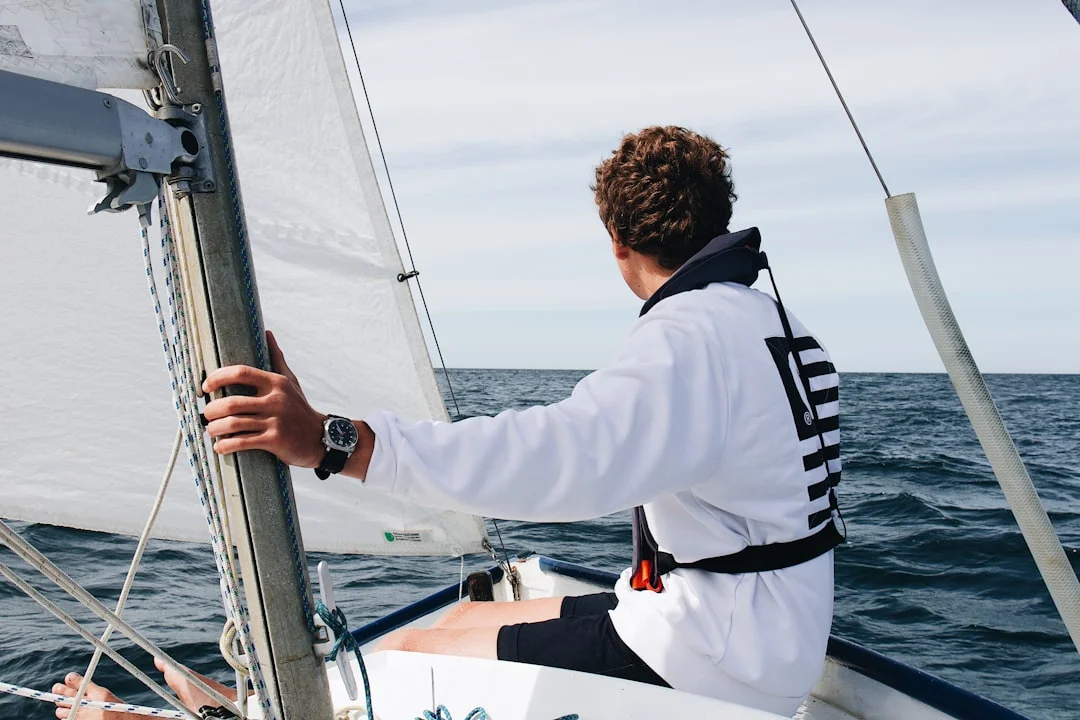
Photo by Maël BALLAND on Unsplash
Crew Briefing and Role Assignment
Before every passage — even a day sail — the skipper should brief the crew on MOB procedures. This takes five minutes and can save a life. Here's a practical crew role assignment for a 4-person crew:
| Role | Person | Responsibility |
|---|---|---|
| Spotter | First to see the fall | Point at casualty, never look away, call bearing and distance |
| Helm | Helmsperson or skipper | Execute recovery maneuver, control approach speed |
| Gear | Strongest crew member | Deploy life ring, prepare recovery equipment, rig halyard for lift |
| Comms | Fourth crew member | Press MOB button on GPS, prepare VHF for Mayday/Pan-Pan, start engine |
For a two-person crew — which is common on charter boats and cruising yachts — the non-MOB person does everything. This is where practiced procedures and readily accessible gear become even more critical. If you're chartering, particularly choosing between bareboat and skippered options, understanding your crew's MOB capability should factor into that decision.
The Pre-Departure MOB Drill
Run through these questions with your crew before leaving the dock:
- Where is the life ring / horseshoe buoy? Can you reach it in 3 seconds?
- Where is the MOB button on the chartplotter?
- Who is the designated spotter? (First person to see the fall)
- Can everyone start the engine?
- Where is the boarding ladder, and how does it deploy?
- Does everyone's PFD fit properly? Crotch strap on?
If anyone hesitates on these questions, walk through the answers physically. Touch the equipment. Deploy the ladder once. The difference between knowing where the life ring is and being able to throw it under stress is practice.
Night-Time MOB: The Worst-Case Scenario
A man overboard at night is the most dangerous scenario in sailing — bar none. Visibility drops to near zero, depth perception vanishes, and the psychological pressure on the crew multiplies.
Additional night-time protocols:
- All crew on deck must wear PFDs with strobe lights and reflective tape
- The helmsperson should never sail alone on deck at night without being clipped in with a tether — prevention is the only reliable strategy
- If someone does go over, illuminate the area immediately with a spotlight or high-power flashlight. Don't worry about night vision — you need to find the person
- Deploy the dan buoy with its strobe light — that vertical light in the water is your homing beacon
- Call a Pan-Pan immediately on VHF Channel 16: "Pan-Pan, Pan-Pan, Pan-Pan. All stations. This is [vessel name]. Man overboard, position [lat/long], [number] persons in the water. Request immediate assistance."
If you're on a longer offshore passage where coast guard response time could be measured in hours rather than minutes, the crew's ability to self-rescue is everything. Practice MOB drills with a fender in daylight. Then practice at dusk. The difference is sobering.
Prevention: The Best MOB Procedure Is Avoiding One
Every experienced skipper will tell you the same thing: the best man overboard procedure is the one you never have to use. Prevention starts with culture and equipment.
Tethering policy: On offshore passages, many skippers enforce a simple rule — if the boat is heeled more than 15 degrees, if it's dark, or if conditions are above Force 5, everyone on deck is clipped in with a jackline and tether. No exceptions. The tether should be short enough that you can't reach the rail.
One hand for yourself, one for the boat. This old-school seamanship rule still applies. Moving around the deck without holding on — especially going forward to the mast or the bow — is when most falls happen.
Non-skid footwear. Wet teak is slippery. Wet fiberglass is worse. Proper sailing boots with grippy soles are not optional.
Guardrail and lifeline checks. Stanchions bend, lifeline terminals corrode, pelican hooks fatigue. A guardrail that gives way when you lean on it is worse than no guardrail at all — it creates false confidence. Check them as part of your seasonal maintenance.
Avoid single-handing the foredeck in heavy weather. If a sail change is needed at the bow, send two people with harnesses clipped to the jacklines. The second person watches and can react if the first gets swept.
Frequently Asked Questions
What is the correct immediate response to a man overboard situation?
The instant someone falls overboard, shout "Man overboard!" to alert the entire crew. Assign one person as a dedicated spotter who points at the casualty continuously and never looks away. Immediately throw a life ring or any buoyant object toward the person. Press the MOB button on your GPS or chartplotter to mark the position. Then begin your chosen recovery maneuver — typically the quick-stop method, which keeps you closest to the casualty.
How long can a person survive in the water after falling overboard?
Survival time depends heavily on water temperature. In warm tropical waters above 20°C (68°F), a person can survive 12 hours or more. In temperate waters of 10-15°C (50-59°F) — common in the Mediterranean and US East Coast in spring — survival time drops to 1-4 hours. In cold water below 5°C (41°F), such as the North Sea in winter, survival without a survival suit may be as short as 15-45 minutes. Cold shock in the first 3 minutes is actually the biggest killer, causing involuntary gasping and water inhalation.
What is the best MOB recovery maneuver for a shorthanded crew?
For crews of two people, the Lifesling method combined with a quick-stop is the most reliable approach. After the initial quick-stop, the remaining crew member circles the casualty while trailing the Lifesling on its floating line. The person in the water grabs the Lifesling, and the crew member then uses a halyard and winch to hoist them aboard. This system was designed specifically for couples and two-person crews and requires minimal physical strength for the recovery phase.
What MOB safety equipment should every sailboat carry?
At minimum, every sailboat should have: a horseshoe buoy with drogue and strobe mounted at the stern for immediate deployment, a dan buoy or MOB pole for visibility in waves, a Lifesling or dedicated MOB recovery device, a deployable boarding ladder accessible from water level, and a 25-meter throwing line. Every crew member should wear an inflatable PFD with harness, whistle, and light. For offshore passages, adding an AIS MOB beacon and a Personal Locator Beacon (PLB) dramatically increases the chances of recovery.
How often should you practice MOB drills?
At minimum, run a MOB drill at the start of every sailing season and before any offshore passage. On longer cruises with rotating crew, brief every new crew member and run through the maneuver on the first day. A practical drill involves throwing a fender overboard and executing the full recovery sequence — including deploying the boarding ladder and rigging a halyard for hoisting. It takes 20 minutes and reveals problems you'd never find by reading about it. Many experienced cruisers practice quarterly, and racing crews drill before every major event.
Should you jump in to rescue a man overboard?
Almost never. Jumping in to save someone is one of the most dangerous things you can do. You now have two people in the water, the boat is potentially unmanned, and you've halved your available crew for recovery. The exception is extremely limited: if you are a strong swimmer, conditions are calm, water is warm, and the casualty is unconscious and at immediate risk of drowning — and there is still someone aboard to maneuver the boat. In almost every other scenario, stay on the boat and use your equipment and maneuvers to effect the rescue.
About the Author
Related Articles
San Francisco Bay Sailing: Winds, Tides & Hazards Guide
Plan safer San Francisco Bay sailing with wind patterns, tides, currents, fog and key hazards. Use this guide to pick a route and go sail today.
By Breezada Team
Sailboat Engine Won't Start: Diagnostic Flowchart
Troubleshoot a sailboat engine that won't start with a step-by-step flowchart for batteries, starter, fuel, air, glow plugs & alarms. Fix it now.
By Breezada Team
Sailboat Bottom Paint Guide: Types, Costs & Prep
Learn sailboat bottom paint types, costs, and prep steps—plus how often to repaint. Get the right antifouling plan for your boat today.
By Breezada Team
Diesel Heater Troubleshooting Boat: No-Start & Soot Fixes
Fix diesel heater no-start and sooting on your boat. Step-by-step checks for power, fuel, air/exhaust and maintenance—read the guide now.
By Breezada Team